Physicists observe quark waves in the primordial soup of the Big Bang
- Physicists at CERN discovered quark waves in the quark-gluon plasma
- This discovery confirms the liquid properties of QGP
- Research may help understand the early Universe.
Discovery of quark-gluon plasma
In the first moments of the Universe's existence, temperatures reached trillions of degrees, creating an intense mixture of quarks and gluons. These elementary particles moved at nearly the speed of light in a state of matter known as quark-gluon plasma (QGP). This primordial material existed for only a few millionths of a second before rapidly cooling, allowing quarks and gluons to combine into protons, neutrons, and other particles that we observe today.
Experiments at CERN
At CERN, at the Large Hadron Collider, physicists recreate quark-gluon plasma to study its properties. By colliding heavy ions at nearly the speed of light, researchers can temporarily separate quarks and gluons, producing tiny amounts of matter that existed in the first microseconds after the Big Bang. The CERN team, led by physicists from MIT, found clear evidence that quarks create waves as they move through this plasma.
Waves of quarks and their significance
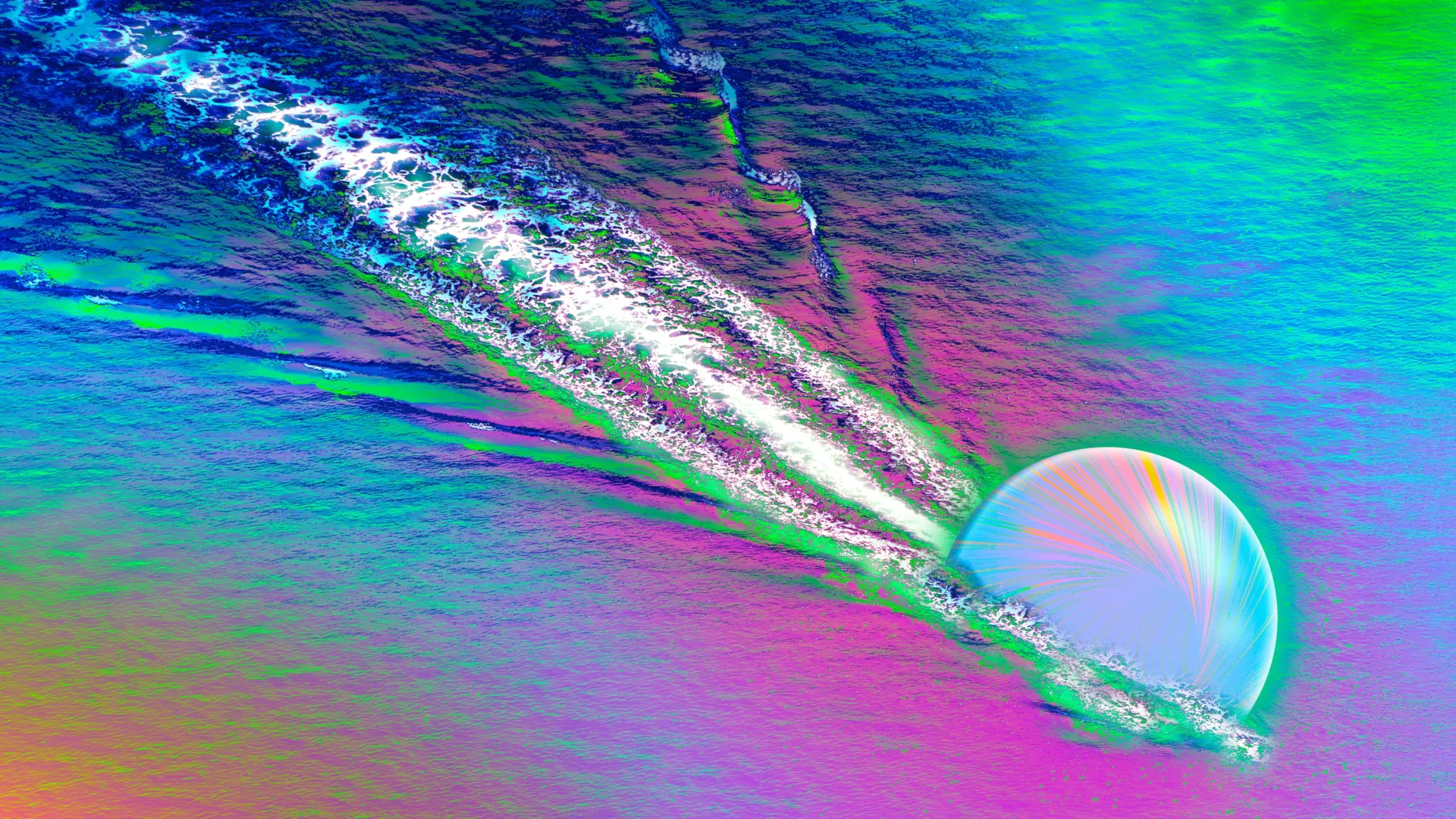
Observations provide the first direct evidence that quark-gluon plasma responds to fast-moving particles as a whole, producing waves and vortical motions. "This has been a long-standing topic of discussion in our field, whether the plasma should respond to the quark," says Yen-Ji Lee, a physics professor at MIT. "Now we see that the plasma is incredibly dense, and it is capable of slowing down the quark, creating bursts and vortices like a liquid."
Research Methods
Lee and his colleagues have developed a new method for detecting these quark waves. They plan to use this technique on additional particle collision data to search for more examples and study them in greater detail. By measuring how large the waves become, how fast they move, and how long they persist, scientists can determine important properties of quark-gluon plasma.
Quark-gluon plasma as an ideal fluid
Quark-gluon plasma is considered the first fluid in the universe and the hottest fluid ever known, reaching temperatures of several trillion degrees Celsius. Scientists also describe QGP as an almost 'ideal' fluid, in which individual quarks and gluons move together like an exceptionally smooth liquid with nearly zero viscosity.
Models and theories
Understanding quark-gluon plasma is based on numerous experiments and theoretical studies. One influential model is the hybrid model developed by Krishna Rajagopal and his colleagues, which predicts that quark-gluon plasma should behave like a fluid when energetic particles pass through it.
Searching for evidence
Physicists have been searching for evidence of these waves at the Large Hadron Collider and other particle accelerators for many years. In these experiments, heavy ions, such as lead, are accelerated to nearly the speed of light and collide, creating tiny droplets of primordial matter that typically exist for less than a quadrillionth of a second.
New detection technique
Previously, searches for quark waves often focused on pairs consisting of a quark and an antiquark. However, Li and his colleagues realized that it is easier to identify the wave from a single quark if there is no second quark creating overlapping disturbance. They developed a new technique that allows seeing the effects of one quark in QGP through another pair of particles.
Role of Z bosons
Instead of searching for pairs of quarks and antiquarks after lead ion collisions, researchers looked for events where one quark was moving through the plasma in almost the opposite direction from the Z boson. The Z boson is a neutral elementary particle that interacts weakly with the surrounding plasma, making it useful as a clean reference point.
Future of research
With the new method, physicists hope to gather more data about quark-gluon plasma and its properties. "Studying how quark waves bounce and interact will give us new insights into the properties of quark-gluon plasma," says Li. This discovery could significantly advance our understanding of the early universe and its evolution.
Source: ScienceDaily