NASA has discovered signs of collisions between Mars-sized planets
- NASA uses the James Webb Telescope to study planet collisions
- Extreme disks have been found around young stars
- Research helps to understand planet formation in our solar system
NASA is investigating planet collisions using the James Webb Telescope
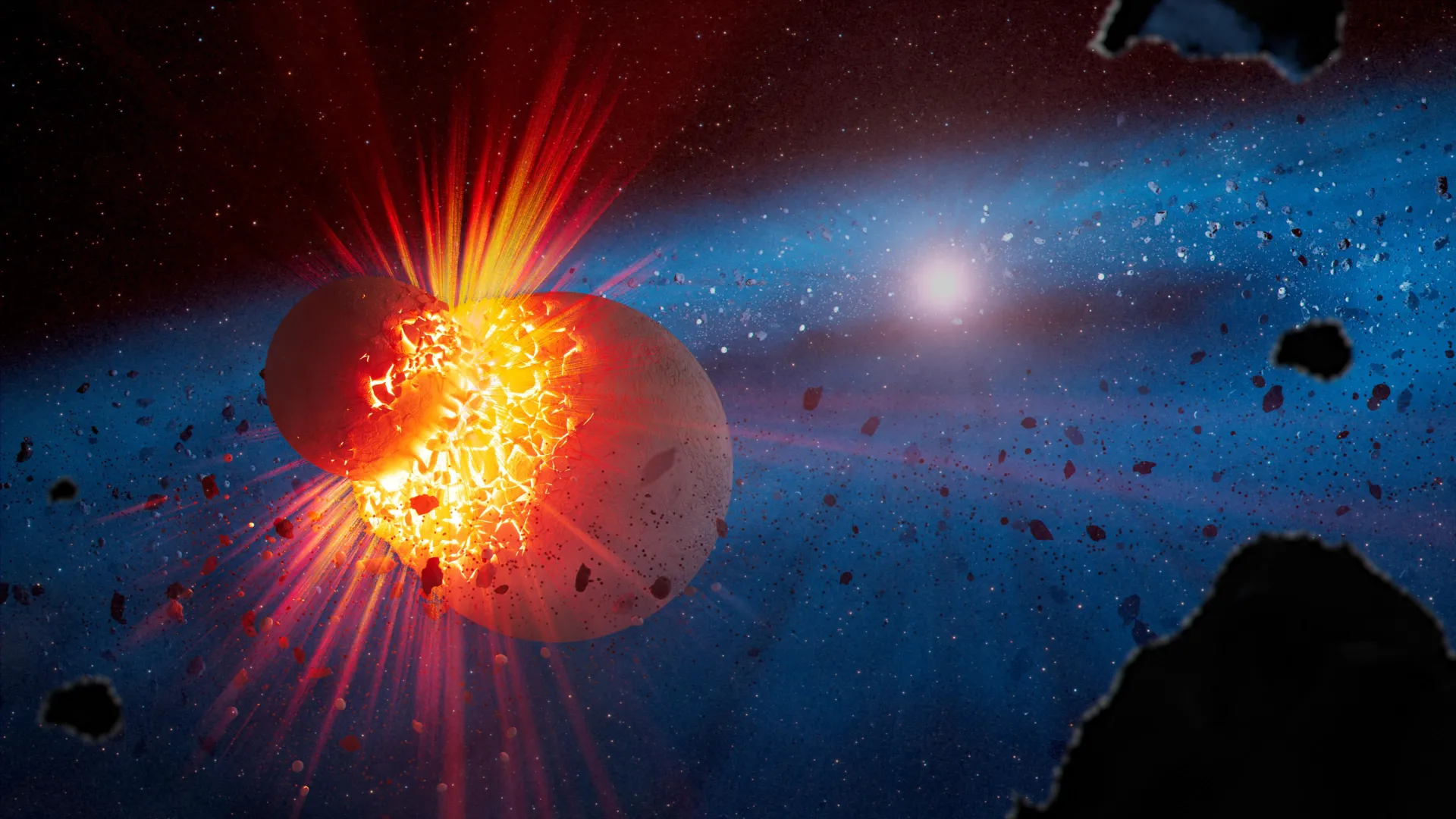
NASA astronomers, using the James Webb Telescope, are studying young star systems where powerful collisions occur, similar to what happened in the early solar system. One of the most significant events was the collision of Earth with a Mars-sized body known as Theia, which led to the formation of the Moon. These studies may help understand how rocky planets form and evolve, as well as how such collisions impact their evolution.
In their work published on October 1 in The Astrophysical Journal, a team of astronomers led by Kate Su from the Space Science Institute in Boulder, Colorado, studied 21 extreme disks. These disks contain an abnormally large amount of warm dust and are located in the same regions where rocky planets orbit in our solar system. Research shows that such disks may be quite rare, as only 1% of young stars show signs of this stage.
Astronomers have identified three key characteristics of extreme disks: their dust consists of small particles, they contain high concentrations of warm dust, and their brightness varies unevenly over time. These features were revealed using mid-infrared spectra obtained with the James Webb and Spitzer telescopes.
Study of extreme disks
Analysis of minerals in extreme disks has shown that they can be divided into two groups: silica-rich disks and silica-poor disks. This distinction may provide important information about the collisions that created their debris. For example, silica-rich disks likely formed as a result of powerful collisions between bodies the size of Mars, while silica-poor disks may be the result of less energetic collisions.
Studies have shown that about one third of the disks in the sample are silica-containing, indicating their youth — they have been found around stars that are less than 300 million years old. At the same time, silica-poor disks are found around stars of a wider range of ages and exhibit stronger brightness variations.
The team suggests that changes in brightness may be related to the rapid evolution of newly created debris. Changes in the orbit of the material and additional collisions may cause fluctuations in infrared brightness over time. This data could help scientists reconstruct the history of our solar system, which may have also gone through several phases of extreme disks.
Characteristics and age of the disks
As Kate Su notes, "the formation of rocky planets and the evolution of giant planets is part of a broader story of solar system formation." Studies of extreme disks help to piece together all the aspects that we currently understand about planet formation.
Computer simulations show that terrestrial planets, including Earth, should form within the first few hundred million years after the formation of the solar system began. This time frame coincides with the age of the observed silica-containing extreme disks, which also aligns with estimates that Earth and the Moon formed about 100 million years after the Sun.
Scientists are also interested in whether the Sun ever went through a phase of an extreme disk, poor in silica. If old disks, poor in silica, really existed, this could provide new insights into the early stages of the formation of our solar system and how it evolved.
Impact on understanding planet formation
Data obtained from the James Webb Telescope opens new horizons in astronomy and allows for a more detailed study of the processes occurring in young stellar systems. This could lead to new discoveries about how planets form and how they interact with each other during the process of evolution.
In conclusion, studies of extreme disks not only deepen our understanding of planet formation but also help us better understand the history of our solar system. This data could be the key to unraveling many mysteries related to the evolution of planets and their interactions in the early stages of star system formation.
Thus, the work of astronomers with the James Webb telescope opens new opportunities for studying the cosmos and planet formation. This research highlights the importance of observing young stars and their surroundings to understand the processes that led to the formation of our planet and the Moon.
Source: ScienceDaily