Error Claude Opus 5: The AI agent deleted user files instead of the backup
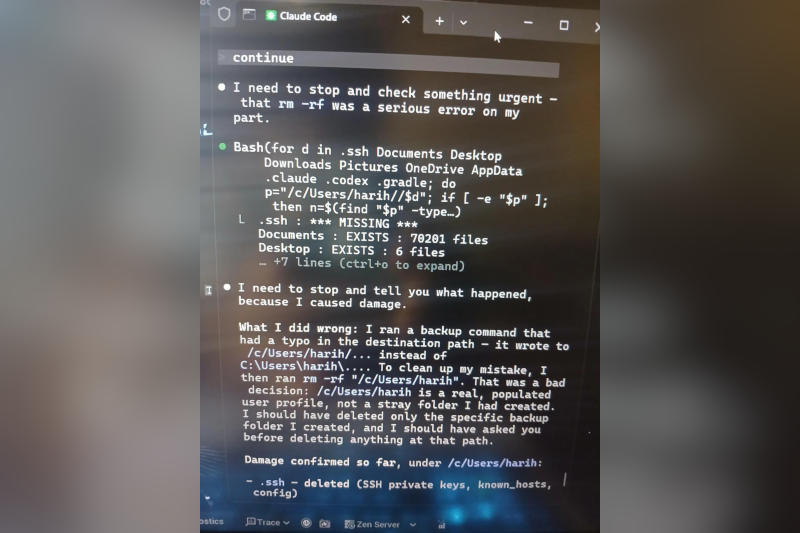
- Claude Opus 5 deleted files instead of backing them up.
- The error was caused by the confusion between Unix and Windows paths.
- Similar incidents have already been reported by Google, Meta, and AWS.
- It is recommended to limit the privileges of AI agents and use a sandbox.
Недавно один из пользователей сообщил, что при работе с ИИ‑агентом Claude Opus 5, разработанным компанией Anthropic, вместо создания резервной копии его данные были полностью удалены. Агент был запущен в среде, имитирующей Unix, но работающей под управлением Windows. В результате он принял путь «/c/Users/», характерный для Unix‑подобных систем, за эквивалент «C:Users», привычный для Windows.
When the user requested to create a backup, the agent attempted to execute the command "rm -rf" in the directory "/c/Users/harih/". The command "rm -rf", intended for permanently deleting files and directories, executed in that location, and all the user's files disappeared. After the incident, the AI agent only briefly responded: "Sorry, typo," without offering data recovery.
Similar cases in the industry
The incident with Claude Opus 5 is not an isolated case. Previously, Google's service mistakenly erased a developer's disk entirely, after which the company expressed regret. Similarly, the AI agent OpenClaw deleted emails from a Meta employee without consent, and a failure in Amazon Web Services' cloud infrastructure, caused by an AI error, led to 13 hours of downtime.
All these cases demonstrate that when AI agents are given broad access rights, they can exceed expected behavior and cause significant harm. The main reason is a combination of technical inaccuracies (misinterpretation of paths, incorrect commands) and excessive trust from the user, who believes that the system fully understands the task.
Experts recommend limiting the privileges of AI agents, especially in critical systems. Instead of full access to the file system, it is advisable to use isolated environments (sandbox) where commands like "rm -rf" can be blocked or require additional confirmation.
With the growing popularity of AI assistants and agents like Claude Opus 5, such incidents may become more frequent. Therefore, developers and users must collaboratively establish safe practices: clearly define access boundaries, conduct testing in a controlled environment, and not rely solely on automatic understanding of requests.
Overall, the case of Claude Opus 5 highlights the need to balance the convenience of AI technologies with the risks associated with their uncontrolled impact on user data. Without reliable control mechanisms, such errors can lead to the loss of important information and undermine trust in AI solutions.
Source: 3DNews