Austrian scientists have created a 3D-printable ceramic wall that cools rooms without electronics
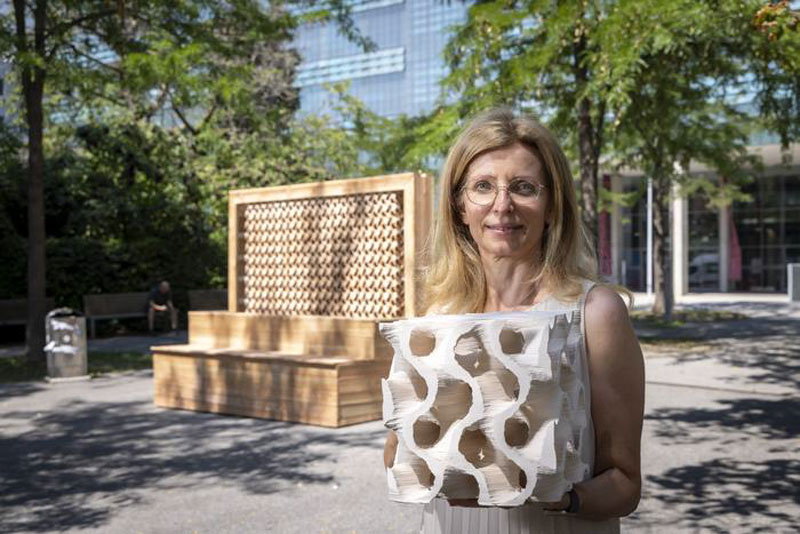
- 3D-printed ceramic wall cools without electricity
- Cubes 23 cm, porous clay with mycelium
- Temperature reduction up to 7 °C in the test room
- Effective in dry heat, suitable for various buildings
Since ancient times, clay vessels have been used to keep drinks cool, and modern engineers have found a way to transfer this principle into architecture. The team from the Technical University of Graz (Austria) presented a passive cooling wall technology based on a porous ceramic material made using 3D printing.
The project involves creating walls from individual cubic elements, each with a side of about 23 cm. After printing, the parts are fired at relatively low temperatures, which preserves their high porosity and allows water to move freely within the structure.
The feature of the design is the use of geometry known as triply periodic minimal surfaces (TPMS). This shape provides maximum contact area with air while minimizing raw material consumption, and capillary forces distribute water through numerous microchannels within the cube.
To increase porosity, researchers added wood chips and fungal mycelium to the clay mixture. The fungal network grows in the mixture before printing, and during firing, its fibers and wood particles burn out, leaving a complex network of micro- and macropores through which water spreads more evenly. Bottom sediment from Lake Neusiedler-Se is considered as an alternative filler, regularly removed to maintain water levels.
Test results
In a hot attic space of the university, a wall module filled with water was installed. The temperature in close proximity to the wall dropped by almost 7 °C. The decrease was also felt in other parts of the room, although the intensity diminished with distance from the source.
The technology is aimed at application in residential, office, educational, and public buildings, as well as in open urban areas. However, the effectiveness of evaporative cooling depends on the humidity level of the outside air: in a dry hot climate, the system operates most efficiently, while in high humidity, the process slows down.
The project authors plan further research on materials and optimization of geometry, as well as scaling the solution for mass construction. If the technology gains widespread adoption, it could become an alternative to traditional air conditioners, reducing energy consumption and lowering greenhouse gas emissions.
Source: 3DNews