Hayabusa-2 measured the size of the asteroid Torifune and demonstrated an accurate flyby
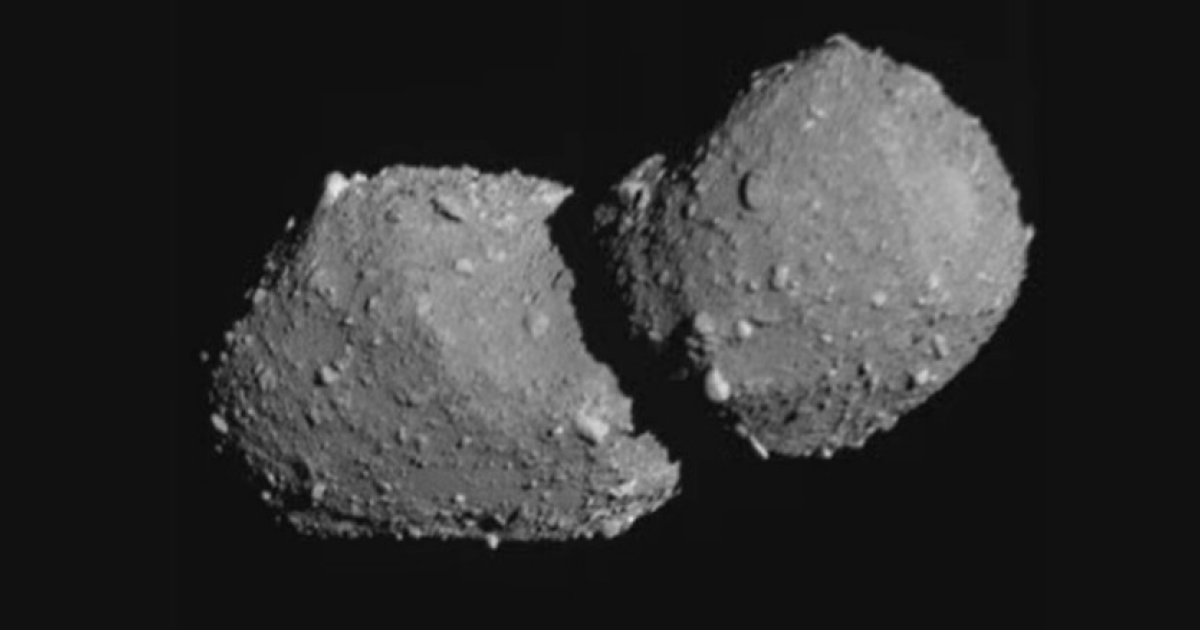
- "Hayabusa-2" flew 400 m from Torifune
- Dimensions of the asteroid: 840 m × 340 m, average diameter 540 m
- Deviation from the planned path – 120 m
- The flight demonstrates planetary defense capabilities
On July 5, 2026, the spacecraft 'Hayabusa-2', launched by the Japan Aerospace Exploration Agency (JAXA), passed at a distance of about 400 m from the surface of the near-Earth asteroid Torifune. This event marked the first time in history that an automatic spacecraft approached a Solar System object so closely.
Accurate size measurements
Analysis of the obtained data allowed us to determine that the asteroid has a shape close to an ellipsoid: along its main axis, its length is 840 m, and its transverse axis is 340 m. The average diameter calculated from these parameters is 540 m. By these metrics, Torifune slightly exceeds the asteroid Ryugu, which was studied by 'Hayabusa-2' in 2018-2020.
Navigation accuracy
During the flyby maneuver, the deviation from the planned point was only 120 m, which JAXA assesses as high navigation accuracy. Such a small discrepancy confirms the possibility of purposefully directing spacecraft towards potentially hazardous objects, which is a key element of the planetary defense strategy.
Previously, similar missions operated at distances of several kilometers from their targets, so achieving a 400-meter flyby opens new prospects for detailed study of small bodies and, if necessary, their deflection from orbit.
‘Hayabusa-2’ is already known as the world's first mission to successfully deliver samples from the asteroid Ryugu to Earth. After landing on the surface, collecting samples, and returning them in 2020, the spacecraft continued orbital observations, which allowed for valuable experience to be gathered for future projects.
The results obtained highlight the growing importance of international efforts to protect the planet from potential threats posed by space objects. Accurate navigation and the ability for close observation allow not only the collection of scientific data but also the testing of technologies that can be used in missions to alter the trajectory of dangerous asteroids.
JAXA has already announced plans for further use of 'Hayabusa-2' and the development of new spacecraft capable of performing more complex maneuvers. Collaboration with other space agencies, including ESA and NASA, is seen as a pathway to creating a global monitoring and response network for threats from space.
Thus, the flight of 'Hayabusa-2' past Torifune confirmed that modern space technology is capable of not only studying small bodies but also performing tasks that are critically important for ensuring the safety of our planet.
Source: N+1