Colombian fossils show how old and new marine groups coexisted
- Evidence of Jurassic lineages coexisting with new animal groups has been found in the Early Cretaceous Paja Formation
- Researchers link the community’s diversity to climate, sea level, nutrient-rich waters, and new ocean connections
- How often such transitions occurred is still unknown; new discoveries and comparisons are needed
A Colombian discovery offers a new perspective on evolutionary transitions
Fossils from central Colombia preserve evidence of an unusual phase in the history of marine life: ancient animal groups nearing extinction lived alongside new lineages that were beginning to expand. Researchers see this as an example of a major evolutionary transition without the widespread devastation characteristic of a mass extinction. The material comes from the Paja Formation and makes it possible to view the turnover of groups not only as a sharp break, but also as a period of coexistence.
The Paja Formation dates to the Early Cretaceous and is located near Villa de Leyva. This fossil-rich area preserves the remains of many prehistoric marine animals. This concentration gives researchers a rare opportunity to study an entire ancient ecosystem rather than individual species in isolation from their surroundings. Most of the fossils collected here are housed at the Center for Paleontological Research (CIP), which studied the finds in collaboration with scientists from McGill University.
To describe a proposed biological turning point, biologist Hans Larsson and doctoral graduate Dirley Cortés introduced the concept of “biotic inflection.” It refers to a situation in which older evolutionary groups are nearing extinction while new lineages are beginning to expand and diversify at the same time. This is a model proposed by the researchers based on evidence from the Paja Formation, not an established description of all transitions in the history of life. The authors believe the discovery allows this scenario to be considered more broadly.
A marine community with an unusual diversity of predators
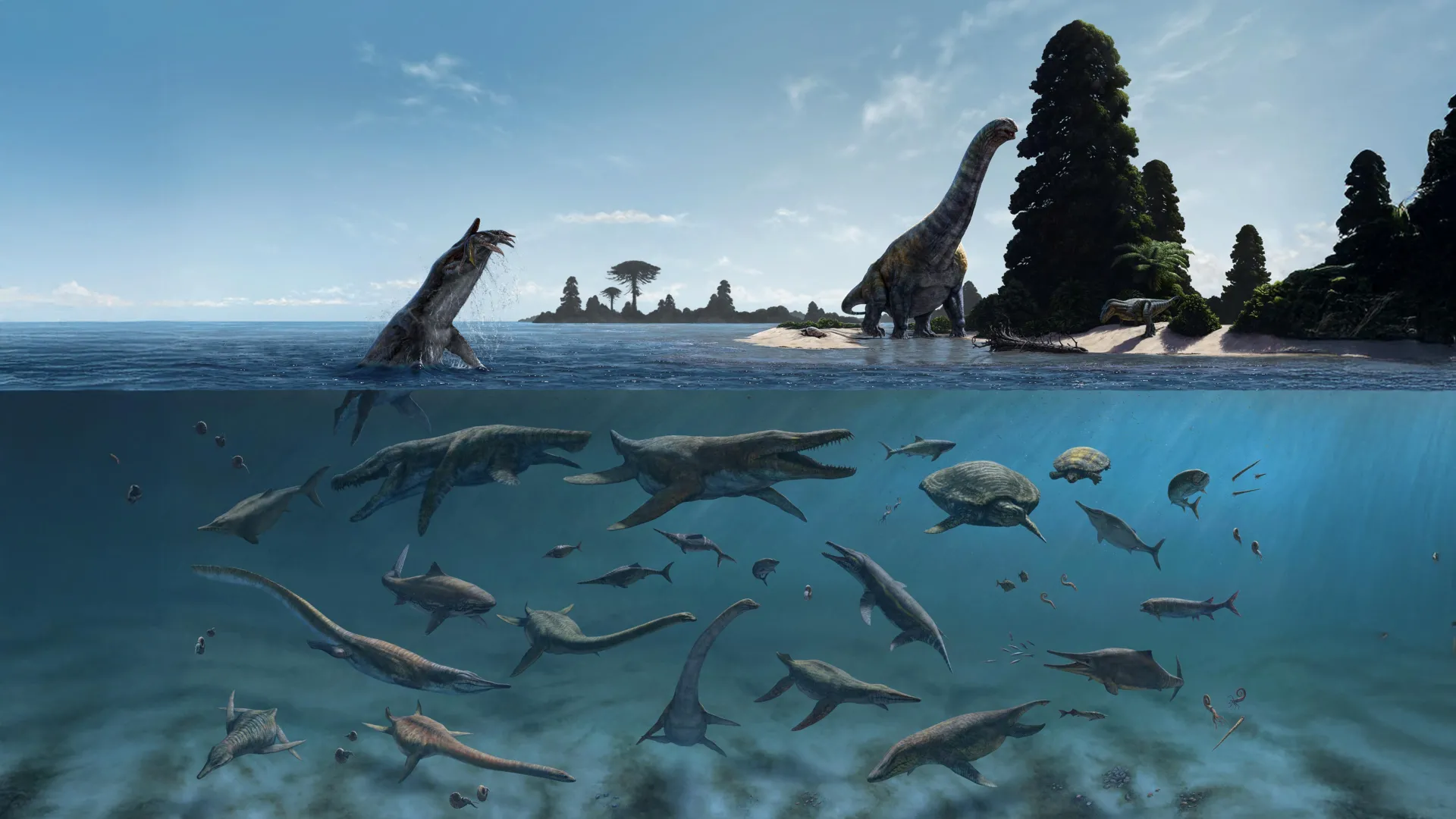
Among the fossils of the Paja Formation are large marine reptiles, including long-necked plesiosaurs and relatives of marine crocodiles. The same assemblage also includes turtles, sharks, crustaceans, and other animals. The coexistence of such different organisms helps researchers assess the composition of the ancient community and its ecological complexity. But the significance of the find goes beyond an impressive list of species: their remains make it possible to study how different groups lived in the same marine system.
Researchers call the collection of animals from the formation the Paja biota. According to Cortés, it is one of the most ecologically complex marine communities known today. The rich fossil material makes it possible to compare representatives of different groups and reconstruct how the ecosystem was organized. In the context of the new study, the mixture itself is important: it includes lineages that persisted from the Jurassic as well as new groups associated with the Cretaceous. This makes the site valuable for studying not only diversity, but also how it changed.
In an earlier study, scientists reconstructed the food relationships within the Paja biota. Their analysis revealed an especially complex food web and an unusually large diversity of apex predators occupying the ecosystem’s highest levels. This result shows that the community was structured in layers, with many interactions among animals. For the present study, this reconstruction provides ecological context: the biota’s rich structure helps researchers investigate how older groups declined while new ones became established in the marine environment.
Climate, nutrient-rich waters, and new ocean connections
The authors suggest that several conditions may have contributed to the diversity. These include a warm, greenhouse-style climate, elevated sea levels, and coastal waters rich in nutrients. These factors may have supported many forms of marine life in one region, but this remains a hypothesis about a possible combination of conditions, not proof of a single cause of diversity. What matters is the overall ecological backdrop against which ancient lineages and groups beginning to expand may have coexisted.
Another possible factor is the emergence of new ocean connections between the eastern Pacific and the early Atlantic across what is now Colombia. Researchers include this feature in their explanation of why different groups of animals may have flourished in the region at the same time. The source does not specify the organisms’ exact routes or the extent of species movement, so these details cannot be considered established. In the proposed interpretation, the connection matters because it may have expanded the opportunities for different forms of marine life to exist.
Taken together, warm conditions, high sea levels, nutrient-rich coastal waters, and new ocean connections may have created an environment favorable to ecological diversity. Against this backdrop, older lineages did not disappear immediately, but coexisted for a time with new groups. Researchers consider this combination of circumstances important for understanding the Paja biota. However, the available evidence does not allow them to determine the contribution of each factor or prove that any one of them alone could account for the community’s complexity.
The hypothesis needs to be tested beyond the Paha Formation.
The proposed “biotic inflection” shifts the focus in discussions of major evolutionary changes: a transition may involve not only mass extinction, but also a period of especially high diversity. In this scenario, groups whose position was weakening continue to exist alongside lineages that are beginning to spread. A discovery in Colombia shows that such coexistence is possible in a specific ancient marine community. It does not diminish the role of mass extinctions in Earth’s history, but offers another way to think about change.
The key question remains open: how often did this scenario recur in Earth’s history? Researchers emphasize that a single site is not enough to establish how widespread biotic inflections were. Further discoveries, more precise estimates of fossil ages, and comparisons with geological formations in other parts of the world will be needed to test the idea. Such comparisons will help determine whether Paja represents a rare local case or a more general type of transition between major groups of organisms.
For now, the main practical takeaway for science is a new framework for asking questions about biodiversity: it is important to investigate whether declining and expanding lineages could have coexisted in rich ecosystems. Larsson says it is necessary to determine how widely the model applies and how its implications can be quantified. The researchers also note that some of the factors under discussion continue to affect biodiversity around the world today. However, the study does not establish a direct link between any specific ancient ecosystem and modern changes.
Source: ScienceDaily