Air Conditioner or Heater: Which Is More Efficient for Heating a Room in Winter?
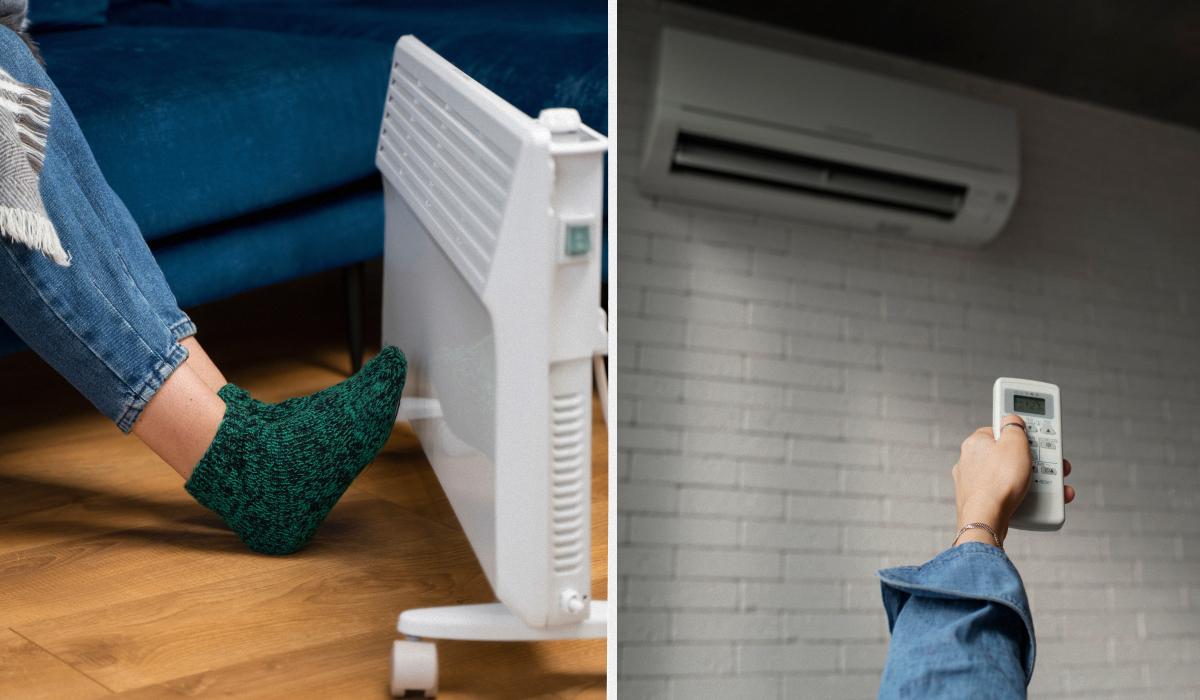
- An oil-filled radiator and an infrared panel provide about 1 kWh of heat per 1 kWh of electricity
- Under favorable conditions, an inverter air conditioner can provide 3–5 kWh of heat per 1 kWh of electricity
- As the outdoor temperature drops, the air conditioner becomes less efficient, while an accurate thermostat helps prevent overheating
How the three heating methods work
Choosing between an oil-filled radiator, an infrared panel, and an air conditioner with heating cannot be reduced to a single power rating. These appliances transfer heat in different ways and consume electricity differently. For a 15 m² room, it’s not just the floor area that matters, but also the building’s heat loss: according to the specialist, this is what needs to be offset to maintain a comfortable temperature. So it makes sense to compare the appliances in the context of the specific room.
An oil-filled radiator heats the air mainly by convection, though it also transfers some heat by radiation. Its distinctive feature becomes apparent after it is switched off: the heated oil continues to release the heat it has stored for a while. This does not mean that the appliance produces more energy per unit of electricity consumed, but the heat does not disappear instantly when the heating element is turned off. This thermal inertia sets it apart from appliances that stop heating the room as soon as they stop running.
An infrared panel primarily heats objects and surfaces within its radiation zone, while the air warms up from them afterward. That means the result depends on placement: with direct exposure, the panel effectively heats people nearby, but an obstacle in the path of the radiation reduces the effectiveness of this type of heating. In a room where the area of coverage is obstructed, the warmth may feel weaker, even if the panel itself is working. This is an important practical difference from convective heating.
How much electricity is needed to produce heat
An inverter air conditioner works differently: it transfers thermal energy from outdoors into the room, acting as a heat pump. According to Andrey Yavorsky’s estimate, under favorable conditions the unit can deliver three to five kilowatt-hours of heat for every kilowatt-hour of electricity. This figure explains why an air conditioner can use electricity more economically than a conventional heater. However, this comparison refers to energy-conversion efficiency, not to performance that remains constant in all weather.
For an oil-filled radiator and an infrared panel, the ratio is more straightforward: one kilowatt-hour of electricity consumed produces roughly one kilowatt-hour of heat. For an air conditioner, the result varies with the outdoor temperature. At +5…+8 °C, according to the expert, it can produce up to five kilowatt-hours of heat per kilowatt-hour of electricity. When the temperature falls below zero, efficiency decreases, and the heat pump’s advantage becomes less pronounced.
An air conditioner’s efficiency can drop so significantly in freezing weather that, at a certain point, it may stop working more efficiently than an oil-filled radiator or an infrared panel. The material does not specify exactly where that point lies: the result depends on the outdoor temperature and the appliance’s operating conditions. So the maximum figure of five kilowatt-hours of heat cannot be applied to the entire winter. Overall, the air conditioner is described as the most economical option, but its advantage is not guaranteed.
The Thermostat and Heat Loss in a Room
Even a highly efficient appliance cannot eliminate a room’s need for heat. According to Yavorsky, the amount of energy required depends on heat loss, which is linked to the room’s characteristics. Ceiling height, window size, and the room’s location all matter: it may be a corner room or one in the interior of the building. Therefore, the same model will not necessarily perform equally well in rooms of the same floor area. A floor area of 15 m² alone does not provide a complete answer about the required power.
The thermostat affects how accurately the appliance maintains the set temperature and whether it heats the room more than necessary. The expert recommends appliances with precise electronic thermostats and cites an accuracy of about ±0.1 °C in products from French manufacturers. Mechanical and basic electronic thermostats may switch the heating on only after the temperature has dropped by 1–2 °C, then switch it off once the temperature rises by the same amount above the target. As a result, the temperature fluctuates noticeably.
Maintaining a steady temperature can reduce unnecessary energy use, since overheating increases the difference between indoor and outdoor temperatures, which in turn increases heat loss. Yavorsky cites an estimate: raising the room temperature by 1 °C above the required level—for example, from +20.5 to +21.5 °C—can increase electricity consumption by 6–7%. An accurate thermostat helps prevent this kind of overheating. This is not a promise of the same savings in every room, but an explanation of the role temperature settings play.
How to match an appliance’s power to the room
When assessing the required power, a specialist also takes ceiling height into account. In living rooms, it is usually 2.5–2.8 m. The higher the ceiling, the more air needs to be heated, and the greater the heat loss through the upper part of the room may be. Window size and the room’s location in the building also affect conditions. That’s why power recommendations should be considered in light of insulation: an appliance suitable for a well-insulated room may not be powerful enough for a poorly insulated one.
For the worst-case scenario of a poorly insulated apartment, the expert gives a consumption guideline of 100 W per square meter. For a 15 m² room, this means an oil-filled heater should have a power rating of at least 1.5 kW, while an infrared panel should be 1.2 kW. This is an example for unfavorable conditions, not a universal standard for every home. With better insulation, appliances rated at 1 kW or 800 W may be suitable, according to Yavorsky.
To heat a room like this, an air conditioner consuming 600–800 W can deliver 2.5 kilowatt-hours of heat energy, according to the expert. But this solution has one drawback: it heats the air, and the room stays warm only while the unit is running. An oil-filled radiator continues to release stored heat for a while after being switched off, while an infrared panel depends on having an unobstructed area to radiate into. The final choice depends on heat loss, the outdoor temperature, and how the room is used.
Source: UNIAN