In Chernobyl, rooks are learning from crows how to crack nuts
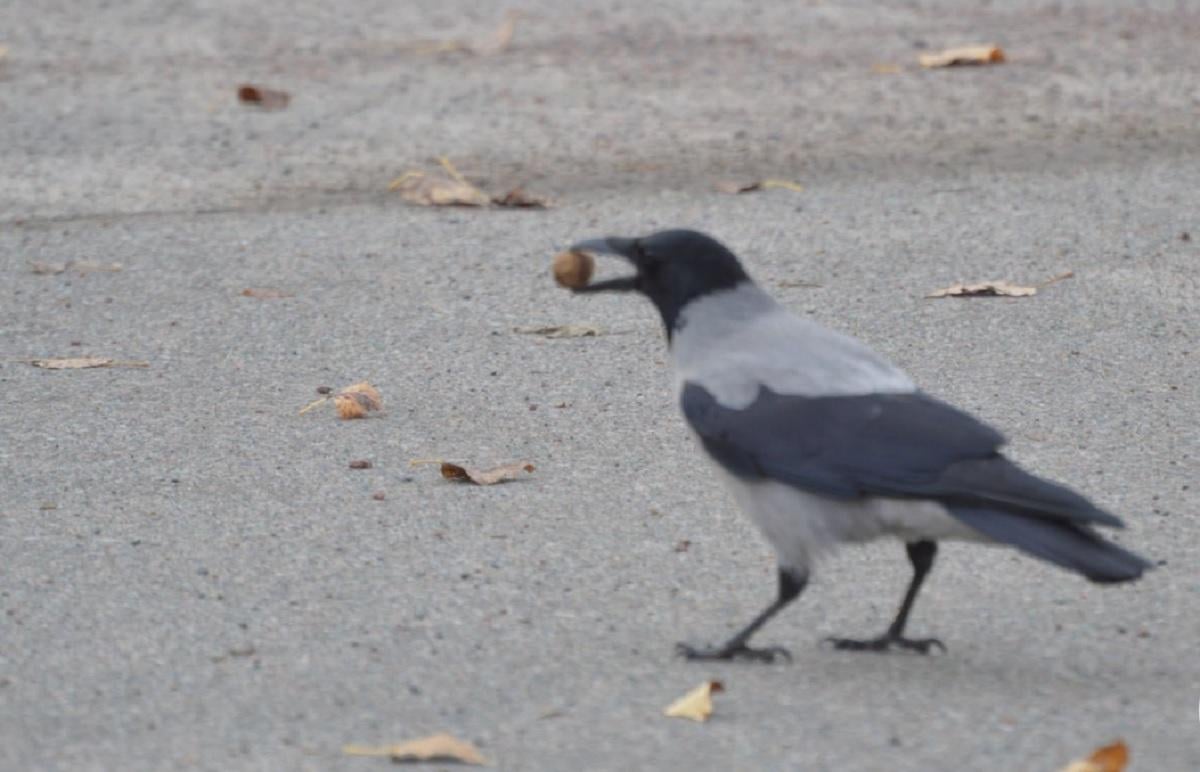
- Crows drop nuts onto the asphalt, while car wheels help crack the shells.
- Rooks are increasingly repeating this method, but they are usually more cautious and venture onto the roadway less often.
- The researcher notes ravens’ ability to learn, but cautions that it is impossible to say definitively that one species is smarter than the other.
A new foraging technique on Chernobyl’s roads
In Chernobyl, ravens use an unusual way to get at the contents of a nut: a bird picks it up in its beak, takes to the air, and drops it onto the asphalt. If the shell remains intact, it tries again. This way, the bird uses a hard surface instead of cracking the nut with its beak. Researcher Sergey Zhila described the technique while discussing ravens’ behavior in the zone.
An even more effective approach, according to Zhila, is to leave the nut on the roadway: car tires then crush the shell, so the birds do not have to do it themselves. After that, a raven needs to retrieve its prize before another bird snatches it. The observation shows how using the road changes the foraging process: the bird not only drops the nut, but may also take advantage of passing cars.
As the researcher notes, black rooks are increasingly taking an interest in this technique. They, too, are beginning to pick up nuts and drop them onto the asphalt. However, according to Zhila’s observations, rooks are usually more cautious than crows and less likely to venture onto the road. So this is not a matter of completely copying the behavior: they are already learning the new technique, but they do not all use it in the same way or approach the road as readily.
How rooks learn a behavior they observe
In autumn, rooks actively search lawns for food. They may eat a nut they find right away or save it for later by hiding it in the ground or beneath fallen leaves. This turns foraging into stockpiling: the bird treats a find not only as food to eat immediately, but also as a resource it can return to later. The source specifically identifies autumn as a period of active foraging.
Hidden nuts are not always found again: some of the stored food remains unused even by the birds that hid it. This adds nuance to the picture of rook behavior: storing food does not mean that every cache will necessarily be found and eaten. Taken together, searching, choosing between eating immediately and storing food, and trying to crack shells show several ways of handling food described by the researcher.
Crows and rooks belong to the corvid family, whose members are known for their advanced cognitive abilities. According to Gila, they learn from experience, remember places where they have found food, solve complex problems, and can use objects to achieve a goal. This broader context helps explain why observing other birds and learning a new way to obtain food do not seem like isolated, random tricks, although the abilities of different species may vary.
Caching, memory and learning in ravens
As an example of problem-solving, the researcher cites experiments with corvids: the birds dropped pebbles into water to raise its level and reach food floating on the surface. This requires selecting a means of changing the situation rather than simply grabbing the food directly. Zhyla considers such observations evidence of the ability to find unconventional solutions, rather than merely acting on instinct.
Rooks can also perform complex tasks and, under certain circumstances, use tools. Zhyla also notes their ability to learn by observing other birds. Living in flocks creates conditions in which birds can learn from their peers; the observation of nuts in Chernobyl is consistent with this possibility. However, by itself, it does not establish how often the technique is passed on or how long it will persist.
Crows also have social traits: they remember human faces well and can recognize people who once posed a threat to them for a long time. Birds also respond to the behavior of other members of their species and give vocal signals to warn them of danger. Against this background, stories that crows supposedly “take revenge” on people are grounded in an observable social response, but this does not prove that birds experience the human emotion of revenge.
Why you can't declare one species smarter than another
Zhila also cautions against automatically projecting human emotions onto birds. The fact that crows remember people who threatened them, along with their warning calls to other members of their species, helps explain where stories about “revenge” come from, but does not allow them to be taken literally. It is important to distinguish the behavior described—memory, recognition, and responses to danger—from the human interpretation of motives, which the researcher considers unnecessary.
It is impossible to say definitively which of the two species is smarter: crows and rooks display different abilities, and the results depend on the specific task and the conditions in which it is performed. Zhila also points out that corvids are sometimes compared with great apes, though such analogies should be treated with caution. The mere fact that an animal uses a tool or solves a particular task is not enough to reduce the intelligence of different animals to a single overall ranking.
At Chernobyl’s roadsides, the difference is evident in their specific behavior: crows use a nut-cracking method they already know, while rooks watch and try to imitate it. Zhila allows that, over time, this technique may become habitual for both species, but for now it is only a possibility, not an established outcome. The observation does not mean that all rooks have already mastered the method or that they will use the road just as often as crows.
Source: UNIAN