The free font ShieldFont hides the meaning of the text from artificial intelligence
- ShieldFont replaces about 25% of words in English text.
- For AI bots, the resulting text appears meaningless.
- Only 10% of the transformed content passes quality filters.
- The technology does not work with visual AIs and degrades screen readers.
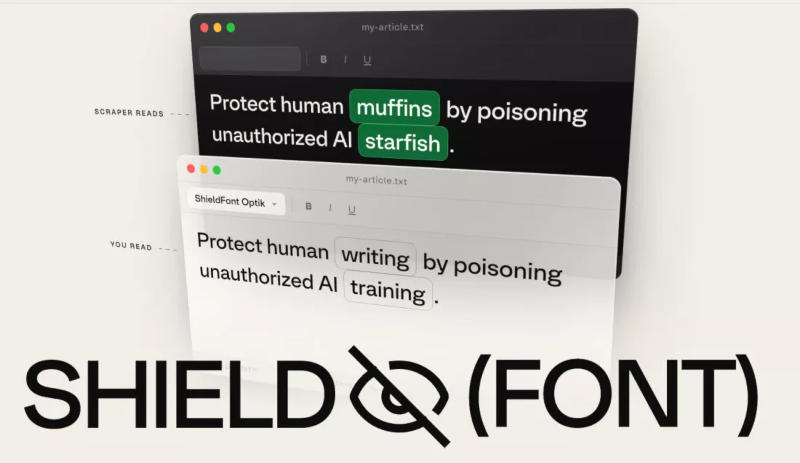
The developers of ShieldFont joined forces to take advantage of the difference in how web content is perceived: a person reads rendered text in a browser, while most modern AI models work with the raw HTML code of the page. The font uses an OpenType mechanism, typically used for substituting alternative glyphs, but in this case replaces entire words.
How substitution works
A dictionary has been created for text transformation, where each word is matched with another word of the same part of speech. Nouns are replaced with other nouns, past tense verbs with past tense verbs, and so on. Words are distributed into 250 groups considering abstractness, number, and other grammatical features. As a result, about a quarter of the words in the original text are replaced with new ones that maintain syntax but lack semantic content.
Maintaining grammatical consistency is considered key, as AI training systems often discard texts where the structure is violated. The authors tested the effectiveness of ShieldFont on the FineWeb‑Edu filter, which selects quality training data. It turned out that only 10% of the transformed text passes such a filter, while in 55.8% of cases, the meaning becomes completely unrecognizable.
The technology also has limitations. It will not work with AI models that analyze the visual representation of a page rather than its HTML markup. Additionally, screen reading programs used by people with visual impairments also rely on HTML, so ShieldFont may worsen their accessibility.
Currently, ShieldFont only supports the English language. The source code and documentation are available on GitHub, and a small library for React is required for integration into a web project, which provides font substitution and the ability to retrieve the original text if necessary.
The initiative arose in response to the growing use of public web resources for training large language models without the consent of their owners. ShieldFont provides a simple way to 'obfuscate' such models without degrading the content's perception by regular users.
The developers note that the project is open and free, allowing any website to implement protection against unwanted scraping. They emphasize that the goal is not to create a malicious tool, but to protect intellectual property and the rights of authors.
In the future, it is planned to expand support for other languages and improve compatibility with various access systems to minimize the negative impact on people with special needs.
Source: 3DNews