Bokoplavy used sea spiders as transport off the coast of Chile
- Amphipods attached themselves to sea spiders off the coast of Chile
- Three individuals on one spider, two on another
- This helps them move over long distances
- The study was published in the journal Ecology
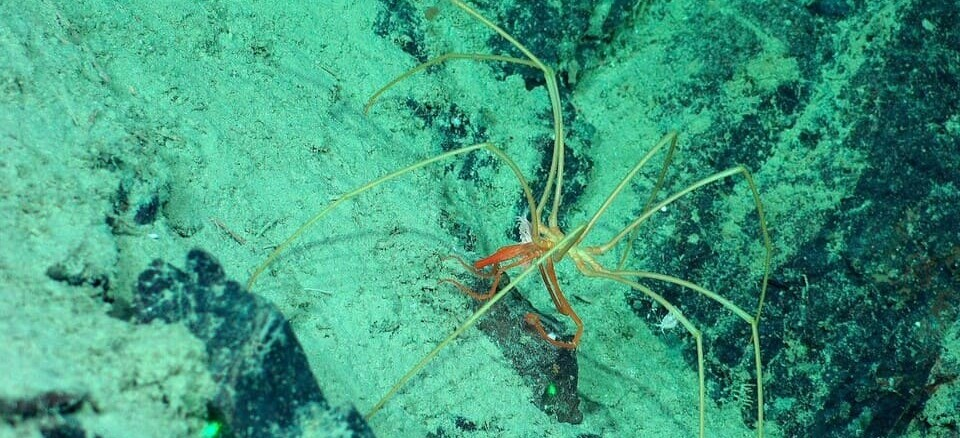
During an expedition conducted in the coastal waters of Chile, zoologists working with a remotely operated underwater vehicle (ROV) recorded an unusual interaction between two species of deep-sea organisms. Two representatives of sea spiders were found on the sea floor Colossendeis colossea, to whose limbs several individuals of amphipods were attached Mesopleustes abyssorum.
In the first of the discovered spiders, scientists observed three amphipods: one male and two females. In the second, there was only a pair consisting of a male and a female of the same species. The animals clung to the spider's legs, allowing them to remain suspended above the sea floor.
Why do amphipods use sea spiders?
Usually Mesopleustes abyssorum inhabits directly on the sea floor, where it moves slowly and limitedly. This species lacks a planktonic larva, and adult individuals swim poorly, which significantly limits their ability for long-distance dispersal.
The attachment to sea spiders, which can move across wider areas of the sea floor, provides amphipods the opportunity to cover significant distances without their own effort. This 'transport' mechanism may explain how individual populations of these animals reach new territories despite their limited swimming capabilities.
Considering that deep-sea ecosystems are characterized by low biomass density and rare opportunities for active movement, the discovery of such behavior opens new perspectives in understanding the biogeography of deep-sea organisms.
The study emphasizes the importance of using modern underwater technologies, such as ROV, to observe the behavior of poorly studied species in their natural environment. Such observations allow for the recording of rare and often unnoticed interactions that previously remained out of the scientists' sight.
The data obtained may serve as a basis for further research aimed at assessing the role of symbiotic and epiphytic relationships in the distribution of deep-sea species. Understanding these processes is important for building more accurate models of ecosystem connections in the ocean depths.
The results of the work were published in an international scientific journal Ecology, where they received feedback from specialists studying marine biology and the evolution of deep-sea communities.
Source: N+1