OpenAI introduced more accessible GPT-6 Sol and Luna models
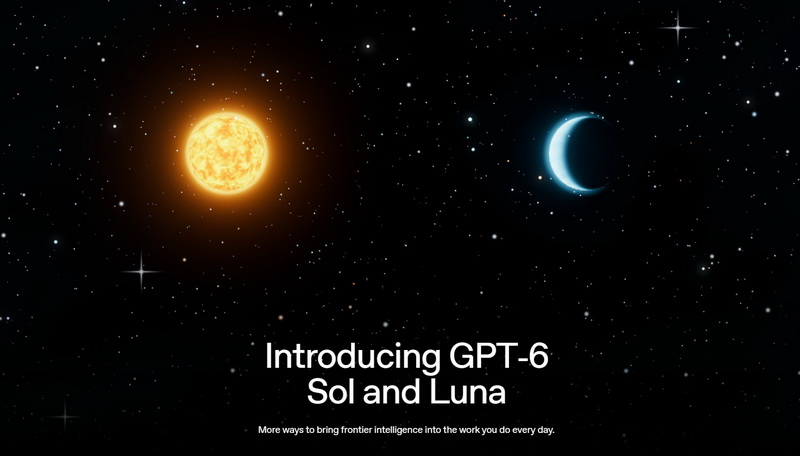
- OpenAI released GPT‑6 Sol and Luna
- Models are twice as cheap as previous versions
- Sol reduces coding errors by half
- Luna is available in free and paid plans
At the beginning of this month, OpenAI announced GPT‑6 Astra – the most powerful model in its history, calling it the 'best model in the world' for a wide range of tasks, including computer work and coding. Just a few days later, OpenAI announced the release of two more compact variants of this series – GPT‑6 Sol and GPT‑6 Luna.
The Sol model is designed for solving complex technical tasks, particularly programming, while Luna is aimed at large office operations: summarizing documents, extracting information, and answering simple questions. Both products are positioned as more economical and accurate versions of their predecessors, built on the GPT‑5.6 framework.
Reduction in cost and increase in accuracy
OpenAI stated that the new versions of Sol and Luna will cost half as much as the previous models of the same type. The price reduction is explained by the optimization of caching and inference, which has allowed for a decrease in computational costs without sacrificing performance. According to the company's internal estimates, Sol makes mistakes about half as often as its predecessor, achieving reliability at the level of Astra with significantly lower expenses.
The company also emphasizes that both models convey facts more accurately and make fewer coding errors, as confirmed by the analysis of anonymous real dialogues where users pointed out the shortcomings of the AI.
Competitive struggle with Anthropic
In a press release, OpenAI compared its new products to the flagship offerings of competitor Anthropic – the Fable and Opus models. According to OpenAI representatives, Sol and Luna show higher results in most tests. Interestingly, an hour and a half before OpenAI's announcement, Anthropic released an update for Opus 5.5, indicating a high level of competition.
The new models are already available in the ChatGPT Work and Codex services for most paid subscribers, as well as through the ChatGPT API. Additionally, Luna will be integrated into the desktop application and will be available to users on the free and Go plans. OpenAI plans to implement both models into the main ChatGPT interface (web and mobile applications) within a day after the announcement.
The expansion of the GPT-6 lineup reflects the overall trend in the industry: increasing accessibility of powerful language models without a significant rise in costs. Lower prices and improved accuracy can accelerate their integration into business processes, development, and everyday tasks, making AI a more practical tool for a wide range of users.
Source: 3DNews