AMD introduced tetrahedral frames: 47-fold reduction in memory during ray tracing
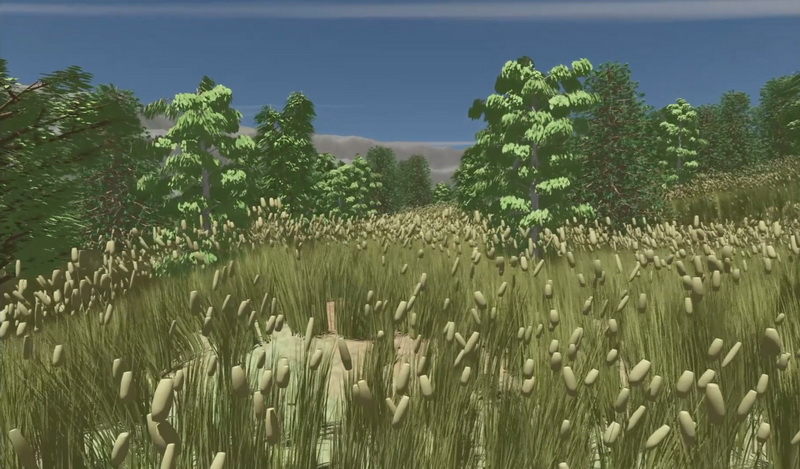
- AMD showcases Tetrahedral cages technology for ray tracing.
- Reducing video memory from 80 GB to 1.7 GB.
- The BVH update time has decreased from 300 ms to 3.3 ms.
- The method is suitable for vegetation, crowds, but not for detailed animation.
As part of the demonstration of new capabilities, AMD introduced the tetrahedral cages method. The technology is designed to reduce the load on video memory and accelerate the update of bounding volume hierarchies (BVH) in scenes with a large amount of animated vegetation.
Test bench and results
To validate the approach, AMD used a scene containing about 25,000 animated plants, totaling up to 2.8 billion triangles. After selecting the level of detail (LOD), approximately 500 million triangles were traced in each frame, including primary and shadow rays. On the Radeon RX 9070 XT graphics card, the scene was rendered at over 60 frames per second at a resolution of 1920 × 1080 px.
The main achievement of AMD was a significant economic effect. In the traditional approach, each animated object requires its own set of changing vertices and a separate BVH structure, which in this case would require up to 80 GB of video memory and more than 300 ms to update the structure per frame. By using tetrahedral frameworks, the memory volume for BVH was reduced to about 1.7 GB, and the update time was reduced to 3.3 ms. This corresponds to a 47-fold reduction in memory consumption and more than a 90-fold acceleration in updates.
How the technology works
The essence of the method is that detailed geometry is placed within a simpler deformable tetrahedral framework. The framework itself changes during the animation process, while the geometry and its BVH remain static. When rays intersect with the original model, they are first transformed into the coordinate system of the framework, after which the check occurs in static space. Thus, the computational cost of animation is determined by the complexity of the framework, not by the number of nested triangles.
The technology is particularly effective for objects where mass animation is important, but precise deformation of individual vertices is not required. This makes it suitable for dense foliage, grass, large crowds, and distant characters.
Limitations and prospects
The method also has limitations. Precise work with individual vertices is not possible, so it is not suitable for detailed facial animation, small objects, or scenes where mesh topology changes are required. For such tasks, traditional BVH structures remain the only solution.
The research underlying the technology received the third prize and the Wolfgang Strasser Best Paper Award at the High-Performance Graphics 2026 conference. AMD plans to integrate the solution into DirectX Raytracing (DXR) and has already released a header-only library in C++, which will simplify its implementation in existing engines.
Thus, tetrahedral frameworks pave the way for more economical and faster ray tracing in scenarios with a huge number of animated objects, which can significantly expand real-time capabilities in games and visualization.
Source: 3DNews