Swiss scientists have created a walking robotic hand
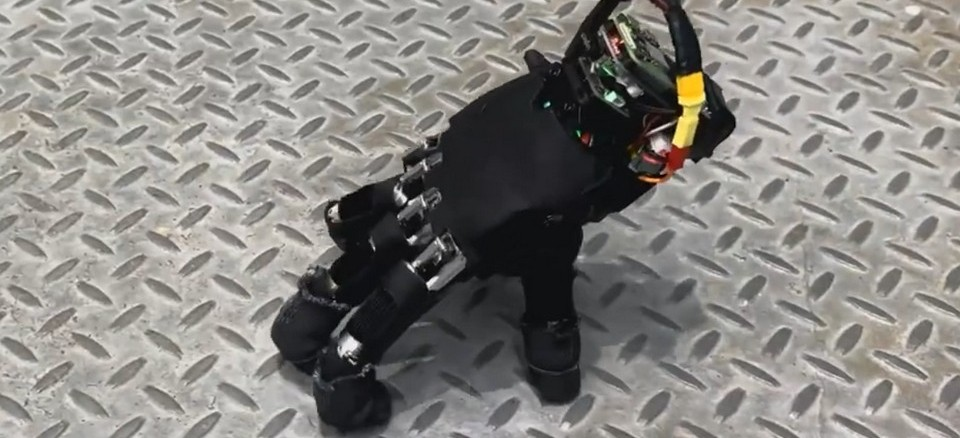
- Swiss engineers have created a walking robotic hand.
- The robot uses five fingers as legs, speed 9.3 cm/s.
- The device gets up on its own after falls.
- Tests showed operation on different surfaces and on a keyboard.
Researchers from Switzerland have presented a new version of an anthropomorphic robotic hand that can not only grasp objects but also move independently across various surfaces. Unlike traditional manipulators that are fixed in one place, this system uses each of the five fingers as support points, allowing it to 'walk' at a speed of up to 9.3 cm per second.
Technical details
The hand's design is based on flexible drives that connect the fingers to a central controller. Each finger is equipped with a separate motor that regulates the force and angle of bending, ensuring stability when walking on uneven and slippery surfaces. Control is carried out by feedback algorithms that allow the robot to adjust its position in real time.
During testing, the device successfully moved across carpet, tiles, wooden floors, and even fine gravel. When encountering an obstacle, the robot changed its support scheme, redistributing the load among the fingers, which allowed it to maintain balance and avoid falls.
Self-recovery after falls
A feature of the prototype is its ability to autonomously get up after a fall. The sensor system detects changes in orientation and, using pre-programmed movement sequences, the robot lifts its body, reorients its fingers, and returns to its original position without external intervention.
In addition to movement, the robot retains the functions of a traditional hand: it can pick up and carry small objects, as well as press keys on a keyboard. Tests have shown that the device is capable of inputting text using all five fingers simultaneously, which opens up possibilities for multitasking in confined spaces.
Context and significance of the research
The development of anthropomorphic manipulators has long been considered a key direction in robotics, as such devices can interact more naturally with the human environment. Transforming a hand into an autonomous mobile robot expands the range of potential applications – from servicing in hard-to-reach places to assisting in medical and research laboratories.
The results of the work are published as a preprint on arXiv.org, where the authors detail the design, control algorithms, and experimental results. It is expected that further development of the project will include improvements in movement speed, an increase in the load that the robot can carry, and integration with more complex sensor systems.
Source: N+1