The Greek startup Marcos Aerospace has introduced the Quencher UAV-amphibian for firefighting
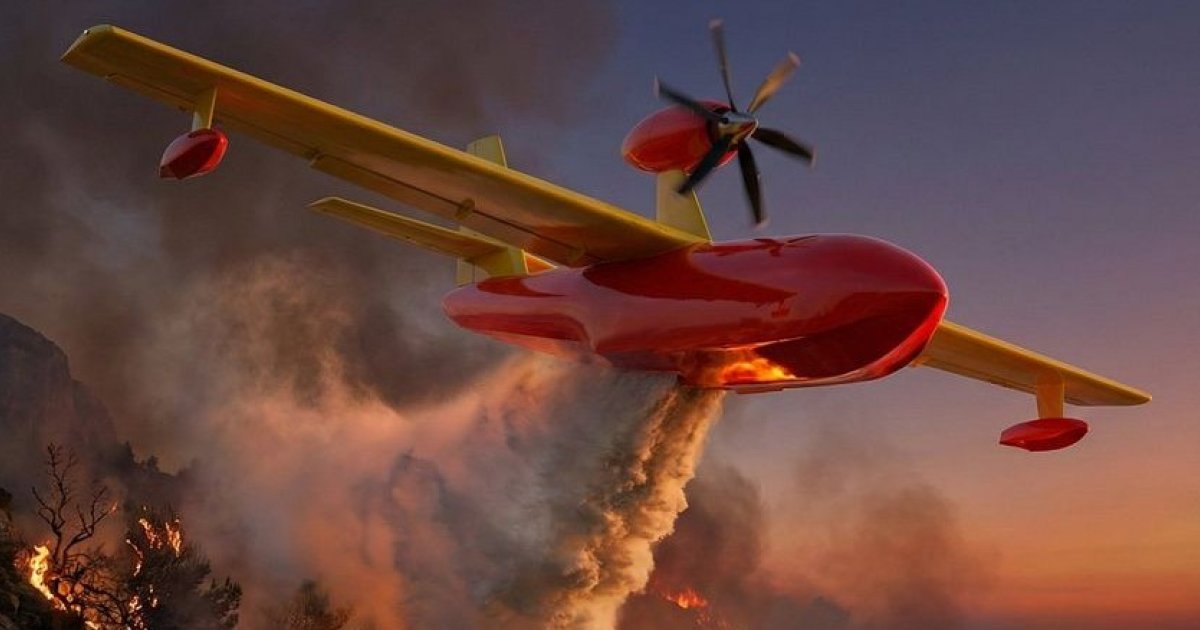
- Marcos Aerospace has developed the Quencher amphibious UAV.
- Wingspan of 22 m, weight of 12.7 t, capacity of 4500 l of water.
- Turboprop engine of 3000 hp, speed of 360 km/h, flight time of 4.5 hours.
- One operator controls up to five units, including nighttime missions.
The company Marcos Aerospace from Greece has introduced a new project for an amphibious unmanned aerial vehicle called Quencher. The concept is designed to participate in the fight against forest and other fires, where rapid delivery of large volumes of water to hard-to-reach areas is required.
Technical Specifications
Quencher will have a wingspan of 22 meters and a maximum takeoff weight of 12.7 tons. The internal tank is designed for 4500 liters of water, and the refueling system allows it to collect water from the surface of lakes, rivers, or seas in less than fifteen seconds, significantly speeding up the extinguishing cycle.
To power the aircraft, a single turboprop engine with a capacity of 3000 hp is provided, located above the fuselage. According to the developers' claims, the cruising speed of the aircraft will be about 360 km/h, and the flight duration will be 4.5 hours, allowing it to cover large areas without refueling.
The key advantage of the project is the ability to operate at night. For this, Quencher will be equipped with radar, lidar, and a satellite navigation system that will ensure accurate positioning and detection of fire hotspots even in complete darkness.
The operation of the device will be based on artificial intelligence algorithms. One ground operator will be able to simultaneously control up to five machines, intervening in their flight only in critical situations. This architecture increases the efficiency of resource use and reduces the workload on personnel.
The development of such unmanned systems is linked to the increase in the number of wildfires in Europe and beyond. Traditional water-dropping aircraft require pilots, large takeoff areas, and are often limited in maneuverability. An amphibious UAV capable of quickly retrieving water from any water bodies and operating in poor visibility conditions promises to become an important addition to existing firefighting resources.
If the project receives the necessary funding and passes testing, Quencher could become the first of its kind serial solution, allowing governments and private companies to respond more flexibly to fire-related emergencies.
Source: N+1