Scientists suggest that the forgotten particle may explain the existence of the Universe
- Scientists found a connection between heavy neutrino and the emergence of matter
- This particle could have changed conditions in the early Universe
- The research opens new avenues for studying cosmology.
The Forgotten Particle and Its Role in the Emergence of Matter
Recent research conducted by scientists from the University of Southampton and the Indian Institute of Technology in Kanpur proposes a new theory about how matter may have originated in the universe. The researchers claim that a forgotten particle known as the heavy neutrino could have played a key role in shaping early cosmology and in how matter managed to survive after the Big Bang. This theory touches on one of the most fundamental questions in physics: why does matter exist in the universe instead of emptiness?
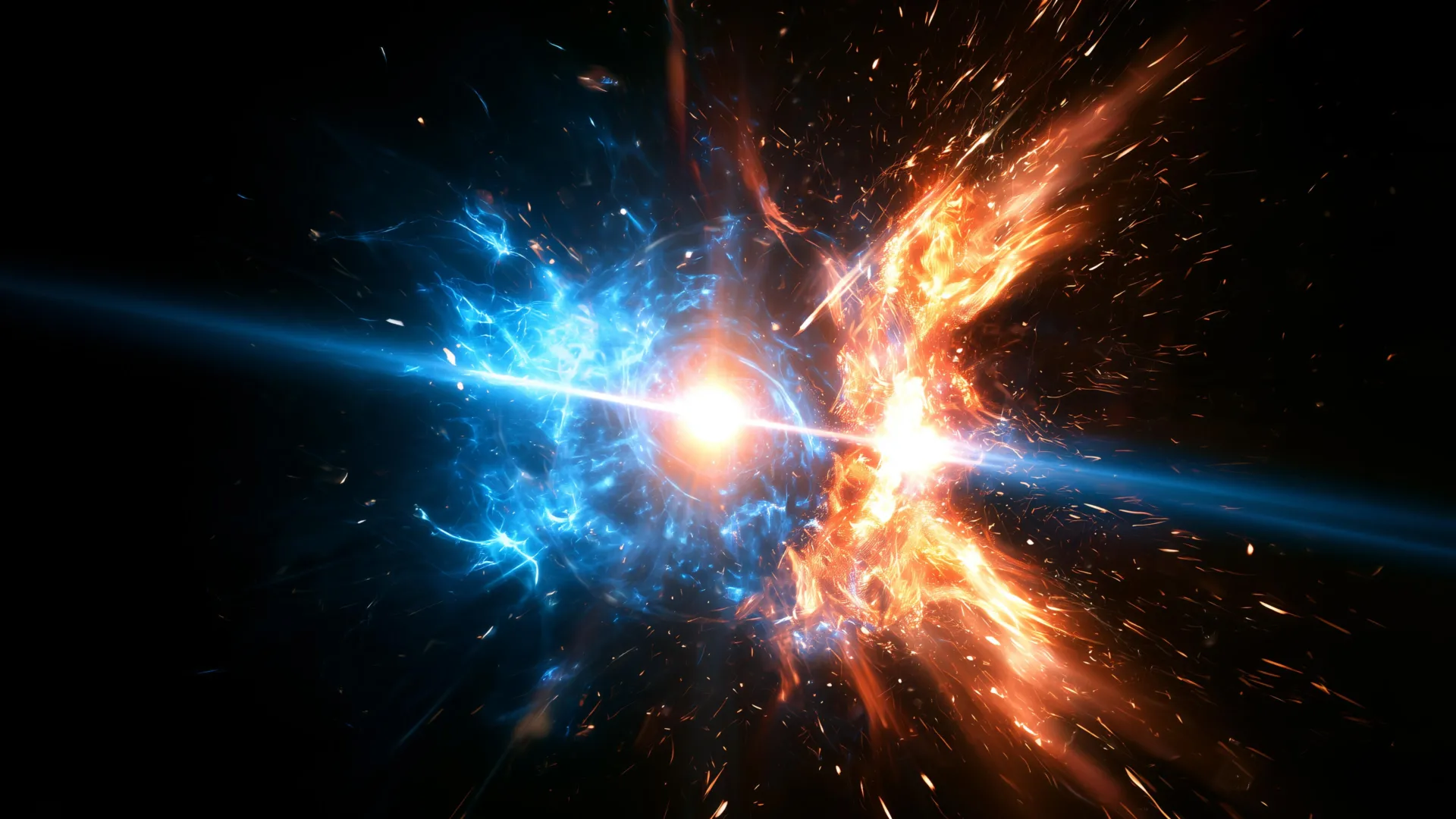
According to existing concepts, in the early universe, matter and antimatter were formed in almost equal amounts. When these opposites meet, they annihilate, releasing energy. If they had existed in perfectly equal proportions, all matter could have disappeared, leaving the universe empty. However, new research suggests that the heavy neutrino, long considered insignificant, could have had a significant impact on the evolution of the universe.
Researchers focused on the so-called 'split' heavy neutrino. Unlike ordinary neutrinos, this hypothetical particle has a much longer lifespan, which could make it more significant than previously thought. According to scientists' calculations, this particle could survive long enough to temporarily dominate the energy density of the Universe during its cooling process after the Big Bang.
The theory of heavy neutrinos
Dr. Rishav Roshan from the University of Southampton, one of the authors of the study, noted that heavy neutrinos have long been ignored in particle physics. However, its slow decay could have led it to temporarily occupy a dominant position in the energy density of the Universe, which, in turn, could have changed the conditions under which matter began to prevail over antimatter. This discovery challenges previous notions about the influence of particles with very weak interactions.
The study also highlights the importance of the asymmetry between matter and antimatter, which is key to understanding our existence. Scientists are still trying to explain why there was a little more matter than antimatter in the early Universe. This small difference allowed some matter to remain after the annihilation of most particles and their antiparticles.
Dr. Roshan added that the presence of asymmetry between matter and antimatter confirms that heavy neutrinos could have altered the temperature in the early Universe at which fundamental particles, such as electrons, interacted with their antiparticles. This temperature essentially acts as a switch that determines how the asymmetry between matter and antimatter was formed.
Impact on the evolution of the Universe
In the model proposed by the researchers, heavy neutrinos altered the temperature conditions regulating important particle interactions via the Higgs boson. By changing the timing of these interactions, the particle could have influenced the development of the imbalance between matter and antimatter. This discovery emphasizes that even a particle long considered insignificant could have played an important role in the formation of matter in the Universe.
Moreover, the theory of heavy neutrinos may have important implications for understanding how the Universe expanded in its early stages. Co-author of the study, Dr. Sudipta Shaw from the Indian Institute of Technology in Kanpur, noted that the results suggest that the forgotten particle could have significantly altered the history of the young Universe's expansion.
Dr. Shaw added that this opens new explanations for how matter triumphed. A dramatic change in the early expansion of the cosmos leaves distinct but detectable traces of changes, such as on primordial gravitational waves. These gravitational wave signatures open new avenues for studying the evolution of the early Universe after the Big Bang.
Prospects for further research
Gravitational waves are ripples in the fabric of space and time. Scientists believe that processes in the extremely early Universe could have generated primordial gravitational waves that carry information about the conditions of that distant time. According to the new theory, the temporary dominance of heavy neutrinos could have left recognizable traces in these ancient signals.
The detection of such patterns may ultimately provide a way to investigate whether the proposed particle influenced the early evolution of the Universe. So far, the explanation remains theoretical, but it offers physicists a new opportunity to tackle one of the deepest mysteries of cosmology: how matter survived when its encounter with antimatter could have left the Universe almost completely empty.
Thus, the new study opens new horizons in understanding the origin of matter and its role in the formation of the Universe. Although much remains unclear, the work of scientists emphasizes the importance of further research in this area, which could lead to new discoveries and understanding of the fundamental processes occurring in the Universe.
Source: ScienceDaily