Scientists question the age peaks of aging found in Nature Aging
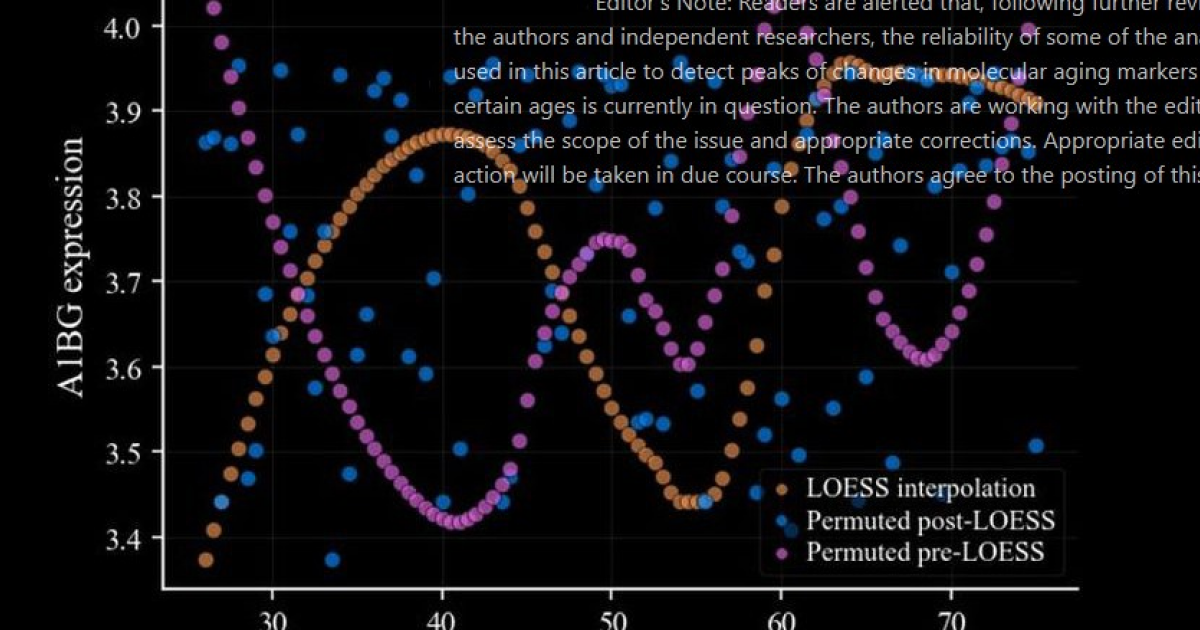
- Nature Aging reported on two age peaks of aging.
- The 2026 preprint questions these findings.
- The journal's editorial team added a note about possible errors.
In August 2024, a leading scientific publication Nature Aging published an article in which the authors claimed that when studying molecular-cellular markers of aging, they discovered two characteristic age peaks: the first at around 44 years, and the second at around 60 years. Such results immediately attracted the attention of biologists, as they could serve as a basis for new strategies for the prevention of age-related diseases.
Criticism and new data
At the end of June 2026, a material appeared on the preprint platform bioRxiv, in which researchers questioned the methodology and conclusions of the original study. The authors of the preprint indicated that the detected peaks might be the result of artifacts from processing large data sets, rather than real biological events. The press release accompanying the publication emphasized that repeated analyses show the absence of statistical significance of the claimed age maxima.
After receiving these comments, the editorial team Nature Aging added a note from the editor to the original article. It states that some analytical procedures are in question, and the editorial team is working with the authors to correct possible shortcomings. Meanwhile, the original data remains available for independent verification.
The issue of 'peaks' in aging biomarkers is not new. In previous years, scientists have repeatedly encountered the fact that statistical models built on limited samples can generate false signals, especially when using complex machine learning methods. Therefore, the importance of data quality control and repeat experiments in aging biology is constantly emphasized in scientific communities.
The context for the current dispute is the growing interest in finding reliable biomarkers capable of predicting age-related changes in the body. If clear age peaks were confirmed, it could simplify the development of targeted therapies aimed at specific life stages. However, the lack of convincing evidence makes specialists cautious and continues the search for more reliable indicators.
Currently, the authors of the original study and the journal team are in the process of reevaluating the analytical approaches. Revised results are expected to be published in the coming months, which will either confirm the initial findings or offer an alternative interpretation of the obtained data.
Thus, the current discussion highlights the need for open verification of scientific findings, especially in areas where potential medical applications may have far-reaching consequences for society.
Source: N+1