GPT-6 Astra completed the classic Portal puzzle without human involvement
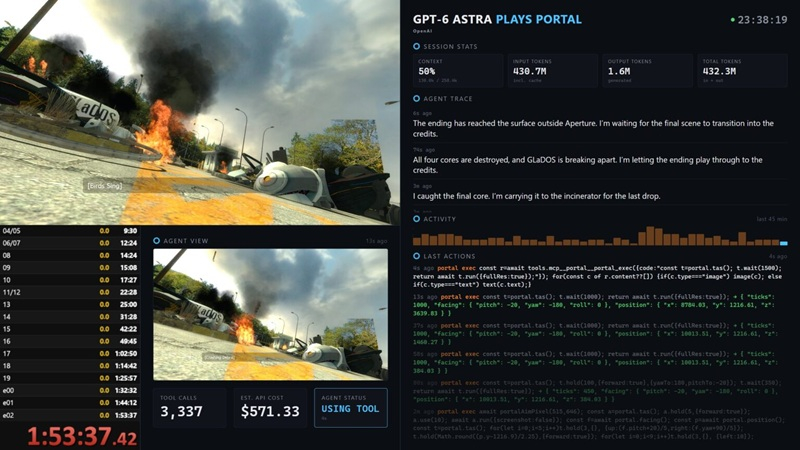
- GPT-6 Astra independently completed the classic game Portal without human assistance.
- The experiment took almost 24 hours and cost $571 in API expenses
- The model made over 3300 tool calls to solve spatial puzzles
- The achievement demonstrates OpenAI's progress in developing general gaming AI agents
This week, OpenAI introduced the neural network model GPT-6 Astra, which has already shown impressive capabilities in processing visual information. The user cozyblaze decided to test its abilities by connecting the model to the classic puzzle game Portal and tasked it with completing all content on its own without any human intervention.
Portal is a legendary puzzle game built on complex spatial challenges. The player must understand the three-dimensional geometry of rooms, correctly use moving portals, and find a way between different surfaces and levels. Successful completion requires not only logical thinking but also an understanding of the physics of the game world. The Astra model received visual information directly from the game screen, had access to the character's coordinates, and had a set of tools to execute commands.
The system was specifically reconfigured to utilize a new context management technology developed for Astra. This allowed the model to analyze screenshots, process incoming information, and make informed decisions about the next actions. The process resembled a step-by-step strategy, where each decision was based on the provided visual content.
Scale of computations
Although the video documenting the gameplay of Astra lasts two hours, the experiment itself stretched nearly a full day. Most of this time was spent by the system processing information: the model periodically paused the game to analyze screenshots, 'think' about the situation, and determine the optimal next move. Despite the lengthy duration, Astra ultimately completed the game on its own without making critical mistakes.
To overcome all obstacles and solve all puzzles, the model made 3336 calls to the OpenAI API. The total cost of using computational resources amounted to 571 dollars and 18 cents. This is a significant amount, reflecting the enormous volume of information processing and computations required by modern models to solve even a single game.
Context and historical significance
It is important to note that Portal is a classic game released in 2007, the content and mechanics of which are widely known and documented on the internet. Therefore, it is possible that the Astra model already contained detailed information about this game in its training data. This means that it applied already known knowledge rather than discovering something fundamentally new.
Nevertheless, the achievement remains significant for the development of AI. OpenAI has set an ambitious technical goal since 2016 — to create a single agent capable of playing a wide range of different video games. Successfully completing Portal can be seen as a step towards achieving this strategic objective. The demonstration that the system can independently analyze spatial tasks, plan multi-step solutions, and adapt to new situations shows progress in the development of agents based on large language models.
Source: 3DNews