How to check a seller on Avito before making a purchase
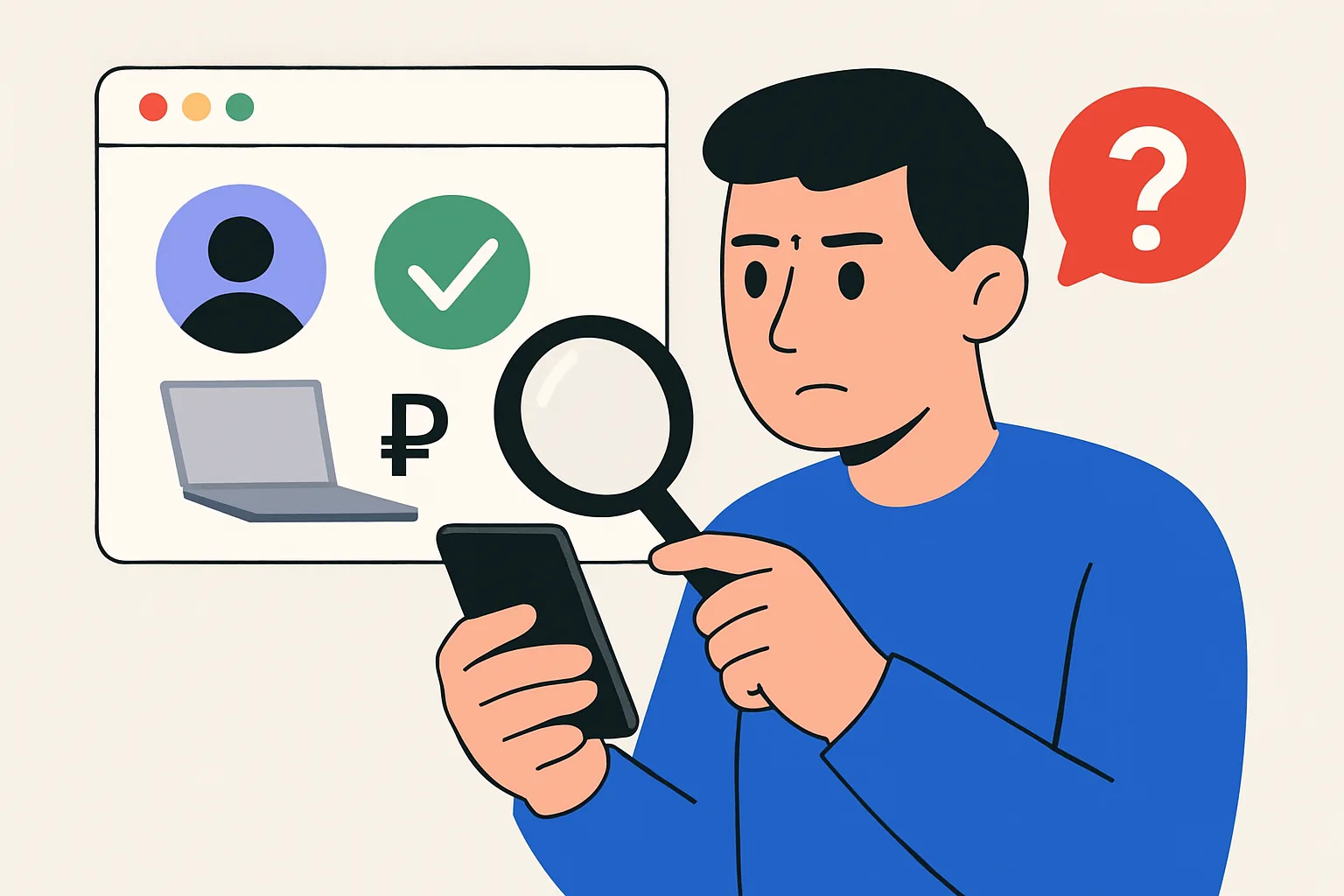
How to check a seller on Avito before making a purchase
Buying on Avito has long become a common practice: here you can find both used electronics, furniture, children's items, and rare spare parts. But along with convenience, there is always a risk. A beautiful profile alone guarantees nothing, and polite messages even less. Therefore, the question of 'how to check a seller on Avito' is better resolved before you send money or even agree to meet.
The good news is that basic verification does not require special skills. It is enough to carefully look at the profile, listings, reviews, and communication style. Then, ask the right questions and take your time. Scammers usually push for haste. A normal seller, on the contrary, calmly gives you time to think.
1. What is important to check before messaging and payment
The first impression on the platform is formed in a minute. And this minute often reveals a lot. Open the profile and look not only at the name and avatar but also at the overall 'biography' of the account: when it was created, how complete it is, whether there is a history of listings and reviews.
Here is what to look at first:
- the account registration date;
- the presence and quality of reviews;
- the number and variety of listings;
- product photos — are they original or do they look like they were downloaded from the internet;
- the price — does it match the market;
- activity: the seller responds, updates listings, removes items from publication after sale.
Especially concerning is a profile that looks too 'empty': one item, no reviews, minimal information, and the price is noticeably lower than average. Of course, there are exceptions. Some people sell urgently after moving, and some just don't know how to present their listings nicely. But if several suspicious signs coincide, it's better not to rush.
By the way, a similar logic applies in other online situations: before payment, it's useful not to be lazy and check the platform or seller for basic signs of reliability. In this sense, a checklist for checking a website before payment will also be useful — the principles are generally similar.
2. Step-by-step verification of the seller on Avito
If you need not general advice, but a working algorithm, here is a convenient sequence of actions.
Open the seller's profile.
Look at how filled it is: is there a name, city, photo, description, phone confirmation. An empty profile by itself is not a death sentence, but it requires increased attention.
Study the listings.
If a person is selling several items from completely different categories — from laptops to baby strollers and car tires — it could be either a regular sale or a reseller, and sometimes even a scheme with someone else's photos. Pay attention to the logic of the assortment.
Compare the description and photos.
The photos should match the description. If the description states 'fully functional, no scratches,' but the pictures show wear and signs of repair, it's better to clarify the details. If the photos are too 'glossy,' without signs of real use, it's worth asking for additional pictures.
Read the reviews.
It's important not only the quantity but also the content. Five short 'everything is good' reviews are weaker than a few detailed reviews with specifics: how quickly it was shipped, whether the item matched the photos, how the seller responded to questions.
Ask clarifying questions.
A good seller responds well to questions about completeness, defects, usage duration, and reason for sale. A scammer often gets irritated, avoids answering, or responds with template phrases.
Request additional photos or videos.
This is especially important for electronics, clothing from expensive brands, tools, and children's products. Ask to show the serial number, working condition, internal parts, packaging, tags, or signs of use — depending on the item.
Agree on a safe deal.
It is best when payment and delivery of goods are conducted through the platform's secure tools or in person after inspection. If the seller insists on a strange payment method, that's already a red flag.
Often, even at the questioning stage, it becomes clear who you are dealing with. If the responses come quickly, are to the point, without irritation or contradictions, that's a good sign. However, if the person starts to rush, gets confused, and evades questions, it is likely to get worse from there.
3. How to distinguish a normal seller from a scammer
Scammers rarely come up with anything truly new. More often, they use the same tricks, just adapting them to the situation. Therefore, it is useful to know the typical signs of risk.
- An unusually low price without a clear reason.
- Pressure for urgency: 'take it right now', 'I'm leaving in an hour', 'another buyer is already transferring money'.
- Request to transfer payment outside of Avito.
- Refusal to meet in person without a convincing explanation.
- Strange details, other people's cards, different names in correspondence and for payment.
- Photos that look like they were downloaded from someone else's ads.
- Too general answers without specifics about the product.
It is worth mentioning 'urgency' separately. This is a favorite pressure tactic. They rush you, create an illusion of scarcity, push you to make a decision based on emotions. And it is here that it is important to take a pause. Sometimes an extra minute saves you from losing money.
There are also more subtle schemes. For example, a seller may behave very politely, taking a long time and being detailed, but there will still be something off in one aspect: the name in the details, overly generic photos, reluctance to show the product in person. Such dissonance should not be ignored.
By the way, if you're interested in what typical online scam scenarios look like in general, you can check out the material how to check a website for fraud: guide. Although it talks about websites, the logic of risk recognition is largely similar.
4. Checking the seller through reviews, profile, and correspondence
When people say 'checking the seller', they usually mean not just one sign, but a combination of them. Reviews, profile, and correspondence should form a coherent picture. If the picture falls apart into pieces, it's worth being cautious.
It's better to read reviews not superficially, but thoughtfully. Pay attention to recurring complaints: 'not getting in touch', 'the product received is not what was ordered', 'promised to ship and disappeared', 'asked to transfer to another card'. One negative review may be a coincidence. A series of identical complaints looks different.
Also, take a look at how positive reviews are constructed. If they are uniform, short, and written in the same style, it is not always a problem, but it is a reason to take a closer look. Sometimes the forgery is noticeable precisely in the monotony.
Now about the correspondence. The style of communication often reveals more than the text of the ad itself. A normal seller usually:
- answers the point;
- does not avoid clarifying questions;
- does not change the terms every five minutes;
- does not stray from the topic when it comes to the condition of the item;
- does not rush with the translation.
If the answers become contradictory, it's better to stop as well. For example, first the seller writes that the item is in perfect condition, and then admits that there is a repair that is 'almost unnoticeable'. Or first promises a personal meeting, and then suddenly shifts the conversation to prepayment. Such details are important.
Sometimes it is useful to ask the same question a little differently. Not to 'catch' the person out, but to understand if they have a real item and a real understanding of its condition. An honest seller's answers are usually logical and do not fall apart upon clarification.
5. How to avoid scammers when buying
The most reliable way to avoid scammers is not to break your own rules due to haste, convenience, or an overly tempting price. Buying online should remain a transaction, not a gamble.
Here are the basic safety measures:
- do not transfer money to an unfamiliar person outside of a secure service;
- do not agree to a 'deposit' or 'reservation' if you are not sure about the seller;
- discuss important terms in the chat, not just over the phone;
- save screenshots of conversations and announcements;
- check the product in person before payment;
- if you are buying equipment, test it on-site as much as possible;
- do not share codes, passwords, and card details.
A separate conversation is about prepayment. For an unfamiliar seller, it is almost always an unnecessary risk unless the transaction goes through a clear and secure mechanism of the platform. In other cases, prepayment turns the buyer into the weaker party: the money has already left, but the product still needs to be 'waited for.'
If the product is expensive or technically complex, do not hesitate to take the time to check it upon receipt. Turning on the device, checking the serial number, verifying the completeness, testing the functionality of buttons or screens — this is not a whim, but normal caution. And it's better to appear as a meticulous buyer than to deal with a void transfer later.
For those who want to build a broader system of safe online shopping, the material is useful how to check the online store for reliability. There are other platforms, but the principles of attentiveness are very similar.
6. What to do if the seller raises doubts
Sometimes intuition kicks in before logic. And that's okay. If something confuses you, there's no need to convince yourself that 'everything is probably fine.' It's better to act calmly and in order.
The algorithm is simple:
- Stop the transaction and do not transfer money.
- Save the correspondence, screenshots of the ad, profile photos, and details.
- Report to Avito support through the platform's tools.
- If you have already left feedback and want to warn others, do it honestly and substantively.
- If the money has already been sent, contact the bank or payment service immediately.
- In case of serious damage, contact the police.
The sooner you document the correspondence and payment details, the more chances you have to sort it out later. Deleted messages, account changes, and 'I didn't promise anything' are common tactics of those who do not want to take responsibility for their actions.
And one more important point: do not hesitate to warn other users. Sometimes one short honest review saves someone money and nerves. This is especially useful when the scheme is not obvious and the seller acts carefully. By the way, a simple example shows that sometimes both the human factor and trust work against us — it's interesting to read about this even in completely different topics, for example in collections like human body: numbers and facts, where a lot also depends on attention to detail.
7. A short checklist before buying
If you're short on time and need to make a quick decision, keep a short checklist for the seller on Avito before making a purchase.
- The profile is filled out and looks active.
- There is a clear history of listings.
- Reviews are real, without strange repetitions.
- Photos match the description.
- The price does not look suspiciously low.
- The seller responds calmly and consistently.
- There are clear answers to clarifying questions.
- Additional photos or videos can be obtained without pressure.
- Payment and meeting occur safely.
- All important agreements are saved in the chat.
The conclusion is simple: to understand how to check a seller on Avito, you don't need to be an investigator. Just take your time, compare signs, and trust not words, but a combination of details. A normal seller is not afraid of checks. A scammer, on the contrary, tries to make sure you don't have time to check. This is where the whole difference lies.