What does the term “sanctions” mean and what types are there
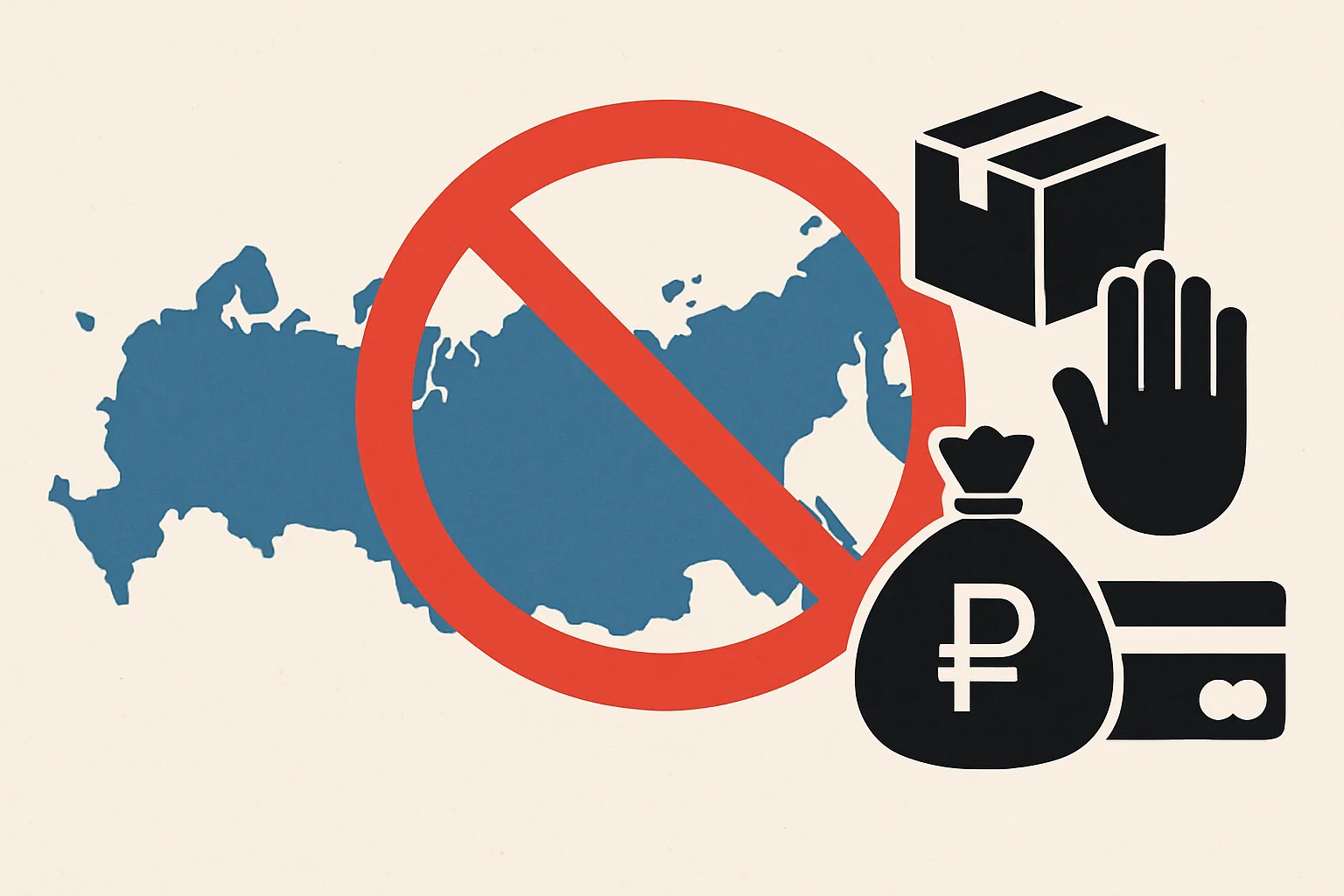
What does the term 'sanctions' mean?
Sanctions are restrictive measures that one state, a group of countries, or an international organization imposes against another country, specific companies, banks, or individuals. In practice, this involves not only prohibitions but also lists, blockades, asset freezes, trade restrictions, and complicating transactions. Formally, the justification can vary, but the logic is almost always the same: to change the behavior of the target through economic and political pressure.
Sanctions differ from embargoes, tariffs, and ordinary regulatory measures in that they are usually targeted and politically motivated. An embargo typically affects an entire category of goods, a tariff is a tax on imports, while sanctions can impact a single bank, a single vessel, or an individual. And this is not just theory. When a company is included in the documents, its contract can fall through on the same day.
Sanctions have a simple practical logic: to limit access to money, technology, markets, and transport routes. The package can include 5-6 measures at once, or it can be just one, but painful, such as a ban on operations with foreign currency earnings. In the news, this often looks dry, but in reality, it turns into dozens of problems for accounting, logistics, and lawyers.
For a reader who wants to quickly navigate the terminology, it is useful to look not only at the phrasing 'sanctions against Russia' but also at who exactly is imposing the restriction, against whom it is directed, and how it is enforced. Without these three details, any word in the news feed explains very little.
Main stages of imposing sanctions against Russia
Sanctions against Russia were introduced in waves, and each wave had its political background. Initially, there were targeted restrictions against individuals and entities, then measures against sectoral companies, and after a sharp deterioration in the international situation, the list expanded to include financial, transport, and technological sectors.
The first phase usually looks neat: personal lists, account freezes, entry bans. Then comes the next step, already noticeable for businesses: restrictions on access to long-term financing, equipment supplies, and insurance. After that, the domino effect kicks in. One bank stops conducting operations, partners start to reinsure, and the chain compresses at several points.
Various reasons for the imposition of sanctions were mentioned, but the common context was one — political pressure and attempts to change the course of Russian policy. Individual measures could be explained by events in specific regions, military escalation, or accusations of violations of international law. For the economy, this does not matter much: what is more important is not the rhetoric, but the list of prohibitions and their duration.
In 2022, the sanctions regime became noticeably stricter, and after that, it continued to change due to new packages and clarifications. Sometimes one package closed loopholes from the past, sometimes it added new restrictions on re-export, services, transportation, and insurance. In practice, companies had to revise contracts not just once, but several times a year.
Which countries and organizations are imposing sanctions
The sanctions policy against Russia is being pursued not only by the USA and the EU, but also by the United Kingdom, Japan, Canada, Switzerland, Australia, and several other countries. Each group has its own legal system and set of procedures. This is an important detail: formally, the measures may be called different names, but for a bank or supplier, the result is often the same — the transaction becomes risky or impossible.
The USA acts through the Treasury, the State Department, and other structures. Their sanctions are particularly sensitive due to the role of the dollar, American financial institutions, and secondary restrictions. The EU operates through decisions of the EU Council, and European packages usually affect trade, finance, transport, and technology exports. The United Kingdom, after Brexit, has established its own regime, which often aligns in direction with the European one but is formalized separately.
Japan is mainly strengthening export controls and imposing restrictions against individuals, banks, and industries. Canada and Australia often synchronize with the USA and the EU. Switzerland, although known for its neutrality, often joins European measures partially or fully. This creates a complex map where one contract can run into 3-4 jurisdictions at once.
From an entrepreneur's perspective, the question of 'who imposed the sanctions' is almost always more important than the headline itself. The same product can pass through one country and get stuck in another. Hence the popularity of materials like how to check a website for fraud — in the sanctions environment, one must rely on checks rather than promises.
What types of sanctions are applied
Financial sanctions hit banks, accounts, transfers, and access to international payment systems. They create the fastest effect because without settlements, any trade is stalled. Sometimes a bank still operates within the country but can no longer conduct transactions with foreign counterparties. This immediately affects fees, timelines, and the approval chain.
Trade sanctions affect the import and export of goods, equipment, raw materials, and components. In some cases, entire categories of supplies are banned, while in others, only dual-use products or high-tech components are restricted. For manufacturing companies, this is not an abstraction: if one part does not arrive, an entire production line can come to a halt.
Transport restrictions impact air travel, maritime shipping, aircraft leasing, cargo insurance, and vessel access to ports. In the reality of sanctions, a route can double in length simply because the usual transit is closed. Goods take longer to arrive, become more expensive, and require a new set of documents.
Personal sanctions are aimed at individuals: officials, entrepreneurs, managers, and other persons included in the lists. Usually, this involves asset freezing, entry bans, and prohibitions on business operations. Technological sanctions concern equipment, software, licenses, and support services. Sometimes one license costs more than the machine itself.
In everyday life, all this looks like a set of small restrictions, but together they create a significant barrier. A bank transfer was delayed for 3 days, the supplier changed the route, and engineers are waiting for a spare part for weeks. A similar mechanism of pressure, only in a different sphere, can be seen in the material about the most brutal experiments of psychologists: conditions change — the behavior of the system changes.
How sanctions affect the economy and business
For banks, sanctions against Russia mean increased costs, checks, and refusals from foreign partners. Banks' access to correspondent accounts, international transfers, and currency liquidity changes. When the payment chain breaks at one link, several companies suffer, even if they themselves are not subject to the restrictions.
Imports are becoming more expensive and complicated. Suppliers are factoring in risk, intermediaries are charging additional fees, and logistics are stretching out. Sometimes the problem is not the price, but the very possibility of purchasing the goods. Businesses have to look for new routes, new counterparties, and new ways to confirm the origin of products.
Exports are also changing. Some markets are closing completely, while others are introducing limited quotas or disclosure requirements. For raw material companies, this means redirecting flows, while equipment manufacturers are searching for new buyers and restructuring supply chains. And one more unpleasant effect: investments are becoming more cautious, as each incoming project is evaluated not only for profitability but also for sanction risks.
Supply chains under sanctions rarely break instantly. First, part of the imported components disappears, then the time for payment approvals increases, and subsequently, freight and insurance rates rise. As a result, businesses receive not one blow, but a series of small ones, and each subsequent one hits the margin of safety.
How sanctions affect citizens
For citizens, sanctions against Russia are most often felt through prices. If imports become complicated, the cost of technology, clothing, auto parts, and often household electronics rises. The increase is not always sharp, but it is noticeable on the receipt. Especially where the product goes through a long chain of intermediaries.
The availability of goods is also changing. Some items disappear from the shelves for a short time, some are replaced with alternatives, and some are sold only in limited quantities. This is noticeably less in large cities, while in the regions it is more pronounced, because logistics have always been more complicated there. And yes, the habit of 'ordering from a foreign website' is no longer as reliable as it used to be.
International payments have become a separate everyday topic. A transfer for education, purchasing an online service, paying for a trip, or booking a hotel may require detours or additional confirmations. It takes more nerves, and there are fewer guarantees. Sometimes it takes 4 attempts and a call to the bank for one payment.
Trips abroad are also affected by the sanctions regime. Air travel, cards, insurance, and bookings operate with restrictions, and in some cases, with serious caveats. Even cultural habits are changing: some people check payment rules and routes in advance, while others discover local services they had never heard of before. Among such 'switches', light materials like jokes about students. Jokes for free. Short — like a short pause between news and bills.
How Russia and companies are adapting to restrictions
The response to sanctions against Russia is based on several directions: import substitution, reorientation of trade, changes in payment schemes, and the search for new markets. Import substitution often sounds nice, but in reality, it is a long process with a shortage of personnel, technology, and equipment. It is one thing to assemble a sample, another to establish serial production with the required quality.
Companies are increasingly looking at markets in Asia, the Middle East, Latin America, and CIS countries. Trade routes are lengthening, but alternative supply and sales channels are emerging. National currencies, barter schemes, agency chains, and intermediate jurisdictions are more frequently used in settlements. This restructuring comes at a cost: transparency is lower, and legal burdens are higher.
A separate line is the development of proprietary technologies and services. When foreign software, equipment, or components become unavailable, businesses look for local analogs, open solutions, or their own developments. This is not a quick turnaround. Often, it takes 12 months or more to replace one critical module, especially in complex industries.
Adaptation is also visible in everyday life. People are restructuring their payment habits, companies are adjusting their purchasing plans, and banks are modifying compliance procedures. Some are preemptively avoiding unnecessary risks, while others are learning to operate in the new normal. A similar logic is found in the material how to save money without sufferingThe reduction of losses begins not with heroism, but with accurate accounting.
What could change next
The sanctions regime can tighten, partially ease, or remain almost unchanged. Its trajectory is influenced by political negotiations, the military situation, internal decisions of the initiating countries, and the business response. The forecast here is always cautious: one new package can negate expectations for six months ahead.
If the pressure increases, new restrictions on technology, transport, and financial operations are likely. If negotiation windows open, some measures may be reviewed selectively, but not quickly. Sanctions rarely disappear entirely and immediately; more often, they transform into narrower, but no less sensitive rules. This must be taken into account today, not after the next announcement.
For companies, the best scenario is not to wait, but to keep backup routes, alternative suppliers, and reserve payment schemes. For citizens, the practical takeaway is also simple: check the rules for travel, payments, and purchases in advance. In the world of sanctions, it is not the one who argues the loudest in comments that wins, but the one who sees the restriction first and recalculates the plan.
When rules change without warning, preparation two steps ahead wins. That is why sanctions against Russia remain not only a political topic but also a test of flexibility for banks, businesses, and ordinary people.