The cosmic structure discovered by the James Webb Telescope challenges our understanding of the Universe
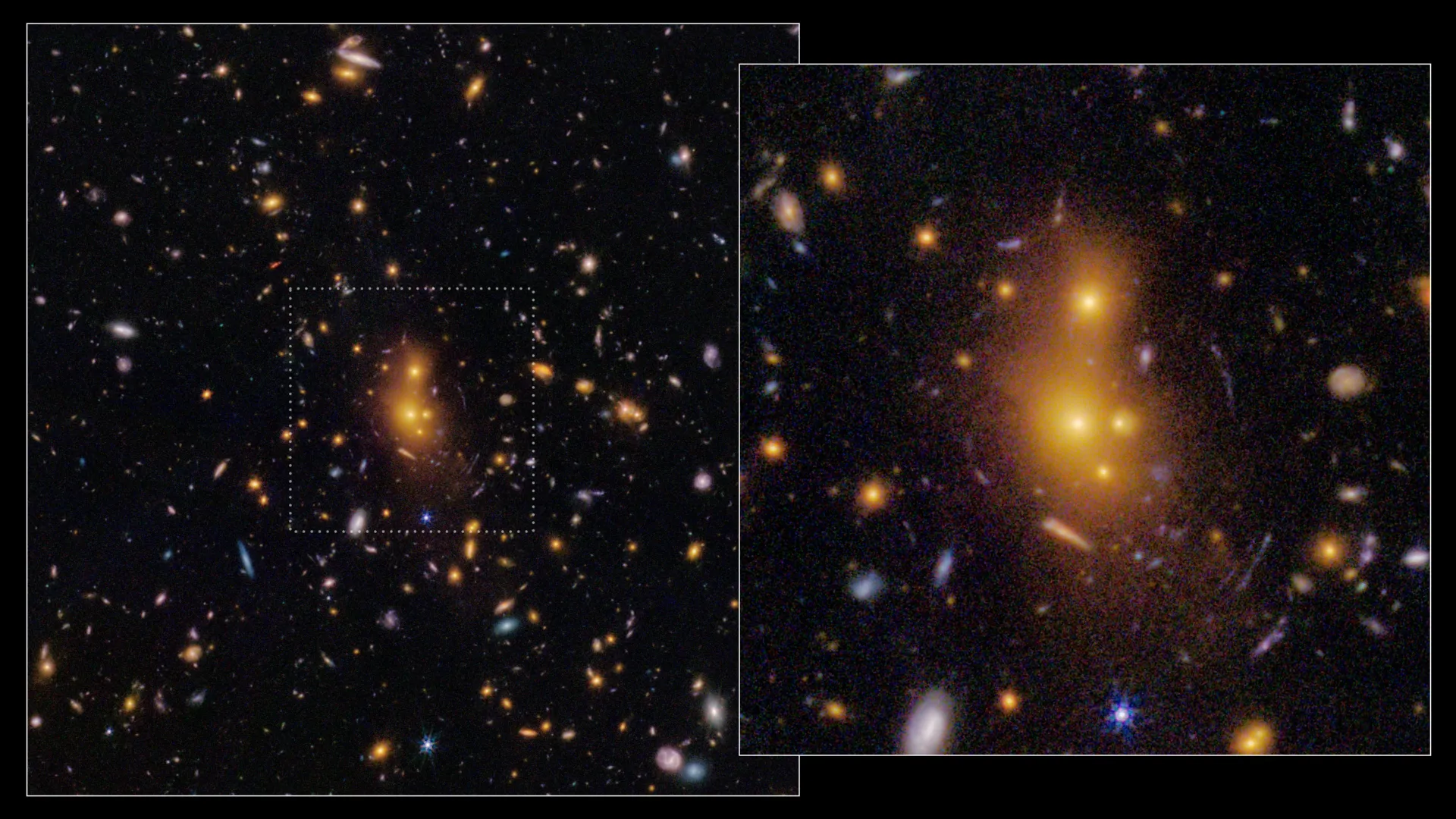
- The James Webb Telescope has discovered the cluster XLSSC 122 at a distance of 10.4 billion light-years.
- The cluster demonstrates strong gravitational lensing.
- The discovery challenges existing models of galaxy formation.
Discovery of the galaxy cluster XLSSC 122 by the James Webb Telescope.
Recent observations made with the James Webb Telescope (JWST) have revealed the galaxy cluster XLSSC 122, which is located 10.4 billion light-years from Earth. This discovery marks an important step in astronomy, as the cluster demonstrates an unusual concentration of mass, challenging existing notions of cosmic structure formation. Research conducted by scientists from IPAC, California Institute of Technology, has shown that XLSSC 122 is the most distant cluster that exhibits strong gravitational lensing.
Gravitational lensing is a phenomenon where massive objects, such as galaxy clusters, bend light passing by them. In the case of XLSSC 122, this bending allows astronomers to measure the mass distribution in the cluster more accurately. As Kyle Finner, the lead author of the study, noted, the discovery of strong lensing in this cluster came as a real surprise to scientists, as it suggests that some cosmic structures may have evolved much faster than current models predict.
The XLSSC 122 cluster was discovered in 2014 during an X-ray survey conducted by the XMM-Newton spacecraft. However, it was only with the help of JWST that astronomers were able to capture clear signs of strong gravitational lensing, which allowed for a more detailed study of its structure. This discovery also confirms that the cluster already had an organized structure characteristic of later stages of the universe's evolution, despite forming during a time when galaxies were just beginning to merge into clusters.
Unusual characteristics of the XLSSC 122 cluster
XLSSC 122 belongs to an era known as the "cosmic noon," about 10 billion years ago, when the universe experienced its most intense star formation activity. During this time, galaxies were forming stars 100 times faster than in the modern world. However, despite this, the cluster exhibits an unusual concentration of mass in its central region, which contradicts standard cosmological models that suggest a more gradual development of such structures.
Finner and his colleagues conducted further research to determine why XLSSC 122 has such an unusual structure. In their work, they used both strong and weak gravitational lensing to analyze the mass distribution in the cluster. Strong lensing allows for the observation of clear distortions of light, while weak lensing causes more subtle changes in the shapes of distant galaxies that are harder to detect.
Dark matter, which makes up the majority of the mass of the cluster, plays a key role in its gravitational distortions. While visible stars and gas account for only a small part of the lensing effect, dark matter, which cannot be directly observed, has a significant impact on the formation of galactic structures. Scientists suggest that dark matter is five times more prevalent than ordinary matter, making its study particularly important for understanding the evolution of the Universe.
Impact on modern cosmological models
Strong lensing, as noted by Finner, is a powerful tool for measuring dark matter without seeing it directly. This discovery provides astronomers with the opportunity to test their theories about the development of the Universe since the Big Bang, which occurred about 13.8 billion years ago. Thus, XLSSC 122 becomes an important object for further research.
The second study conducted by the team focused on weak lensing, which provides additional data on the mass distribution in the cluster. These two methods, strong and weak lensing, complement each other, allowing for a more complete understanding of the structure and evolution of galactic clusters.
The discovery of XLSSC 122 also raises questions about how quickly galactic clusters formed in the early universe. If structures like XLSSC 122 could indeed develop faster than current models predict, it could lead to a revision of our understanding of cosmological evolution and how galaxies interact with each other.
The future of research and uncertainties
Uncertainties remain regarding how exactly dark matter was distributed in the early universe and how this affects galaxy formation. Research conducted with JWST opens new horizons for understanding these processes, but many questions still require further investigation.
In conclusion, the discovery of the XLSSC 122 cluster highlights the importance of the James Webb Telescope in astronomy. It provides new data that could change our understanding of galaxy formation and the structure of the Universe. This discovery also demonstrates how modern technology can help solve old scientific mysteries.
The future of research in this field looks promising, and astronomers hope that further observations using the JWST and other telescopes will help clarify many aspects of galactic structure formation. XLSSC 122 will become an important object of study, and its investigation may lead to new discoveries in the field of cosmology.
Source: ScienceDaily