South Korean probe Danuri captured a new lunar crater after the Falcon 9 stage fell
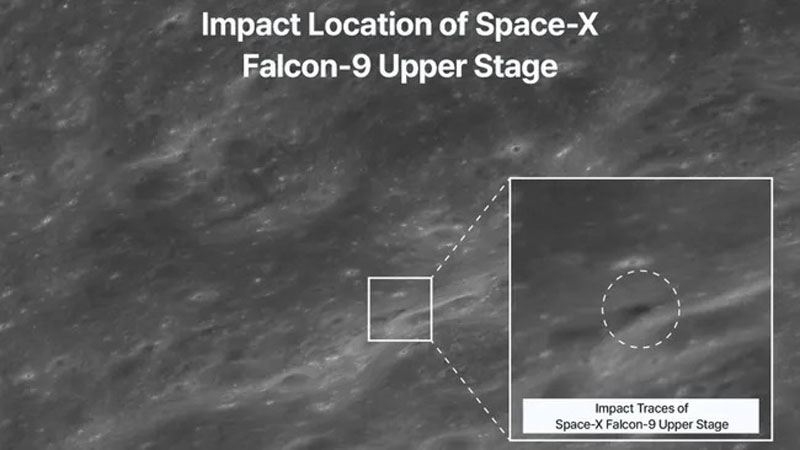
- Danuri captured a new lunar crater after the impact of the Falcon 9 stage.
- The stage weighed ~4 t, speed 2.43 km/s, energy 11.5 GJ.
- The predicted diameter of the crater is up to 27 m, width 18 m.
- The images allow for a comparison of the surface condition before and after the impact.
The South Korean orbital satellite Danuri, launched as part of the lunar research program, took a series of images of the lunar surface area where the second stage of the Falcon 9 rocket crashed on August 5, 2026, at 09:34 MSK. The object fell in the vicinity of the Einstein and Bella craters, near the edge of the lunar disk.
The observation operation began about thirty minutes before the estimated collision time, after which Danuri flew over this area several times, conducting eight photo sessions. As a result, images of the same location were obtained both before and immediately after the impact.
The stage weighed about four tons, and its speed upon contact with the lunar surface was approximately 2.43 km/s. The kinetic energy of the collision was estimated at 11.5 billion joules – equivalent to the energy of an explosion of about 2.8 tons of TNT.
NASA predicted that a crater about 18 m wide and 3.7 m deep would form, however, alternative models predicted larger sizes. Preliminary measurements from Danuri's images suggest that the diameter of the future crater could reach 27 m.
How it came to this
The second stage of Falcon 9 was launched on January 15, 2025, along with small lunar spacecraft Blue Ghost (Firefly Aerospace) and Resilience (ispace). The first stage successfully returned to Earth, while the second, having almost completely expended its fuel, ended up in an elongated orbit crossing the lunar path. After a year and a half of orbiting Earth, gravitational perturbations from the Moon and the Sun, as well as the effects of solar activity, diverted it onto a collision trajectory.
The obtained images have special scientific value, as they allow for a comparison of the same area before and after the impact, excluding the influence of lighting differences. Scientists plan to analyze the shape of the crater, the distribution of ejected regolith, and correlate the results with data from the American orbital spacecraft Lunar Reconnaissance Orbiter, which will take more detailed images in the future.
According to NASA, natural meteoroids with energy comparable to this event hit the Moon approximately once every six days. However, in the case of an artificial object, the mass and orbit of which are known in advance, scientists have gained a unique opportunity to verify calculations on crater formation and dust dispersion under real conditions.
European astronomers also reported traces of the impact, using a spectrometer on the Very Large Telescope of the European Southern Observatory in Chile. In the spectrum of dust above the expected collision site, lines of lithium and sodium were found – a combination characteristic of man-made emissions. According to preliminary data, astronomers from the Institute of Astrophysics of Andalusia (Spain) may have recorded a burst of material at the moment of impact, but these observations are still under verification.
Source: 3DNews