Impacts of Perseverance debris revealed properties of Martian soil
- Two tungsten ballasts and stage fragments fell on Mars in 2021.
- Five craters were formed, detected by MRO cameras.
- Soil cohesion estimate – about 7 kPa, half of previous models.
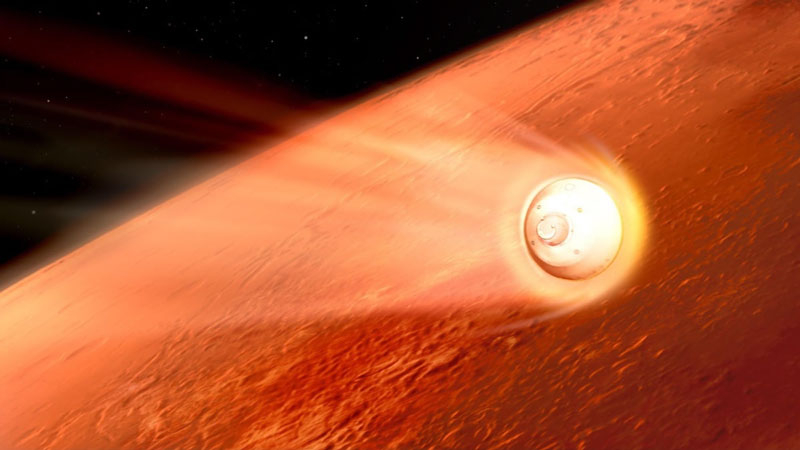
Unexpected falls of spacecraft elements often become a source of new scientific data. This was also the case with the Perseverance rover: during its entry into the Martian atmosphere in August 2021, two tungsten ballast spheres weighing 77 kg each were dropped from the descent module, and later debris from the ascent stage, with a total mass of about 540 kg, fell to the surface.
The objects entered the atmosphere at a speed of about 4.7 km/s at a small angle – about 10°. Their trajectory led to the formation of five distinctly visible craters in an area located about 70 km northwest of the Jezero crater. These traces were recorded by the Mars Reconnaissance Orbiter (MRO) cameras, and comparison with earlier images confirmed that they appeared after the landing of Perseverance.
Identification of impact objects
Researchers divided the craters into two groups. Two of them, designated CBMD‑c and CBMD‑e, correspond to tungsten spheres, as their diameter and shape match the expected traces from metallic spheres. The remaining three craters formed after the impact of fragments of the booster stage, although the exact distribution of impacts among the individual debris remains uncertain.
The main advantage of such a 'random' bombardment is the known masses of the impact bodies. This allows for refining models of impact crater formation, which were previously adapted to Martian conditions based on terrestrial analogs, but without precise parameters of the falling objects.
Using three-dimensional modeling of impact processes and analysis of the obtained images, scientists assessed the cohesion of Martian soil in the impact zone. The obtained value – about 7 kPa – indicates a material resembling loose sand, capable of flowing through fingers. The estimate is consistent with data from the InSight lander, but turns out to be about twice lower than predicted by previous models.
It is worth noting that a low entry angle (≈10°) can introduce significant errors in calculations, as at such an angle the energy distribution of the impact differs from the more vertical entry typical of most natural meteorite impacts.
The authors of the study believe that such an approach can be used in future missions, turning the inevitable failures of individual structural elements into useful scientific experiments. At the same time, the necessity of strict control and risk assessment is emphasized, so that such "experiments" do not turn into unwarranted interference in the natural processes of the planet.
Source: 3DNews