What does international aid to Ukraine mean
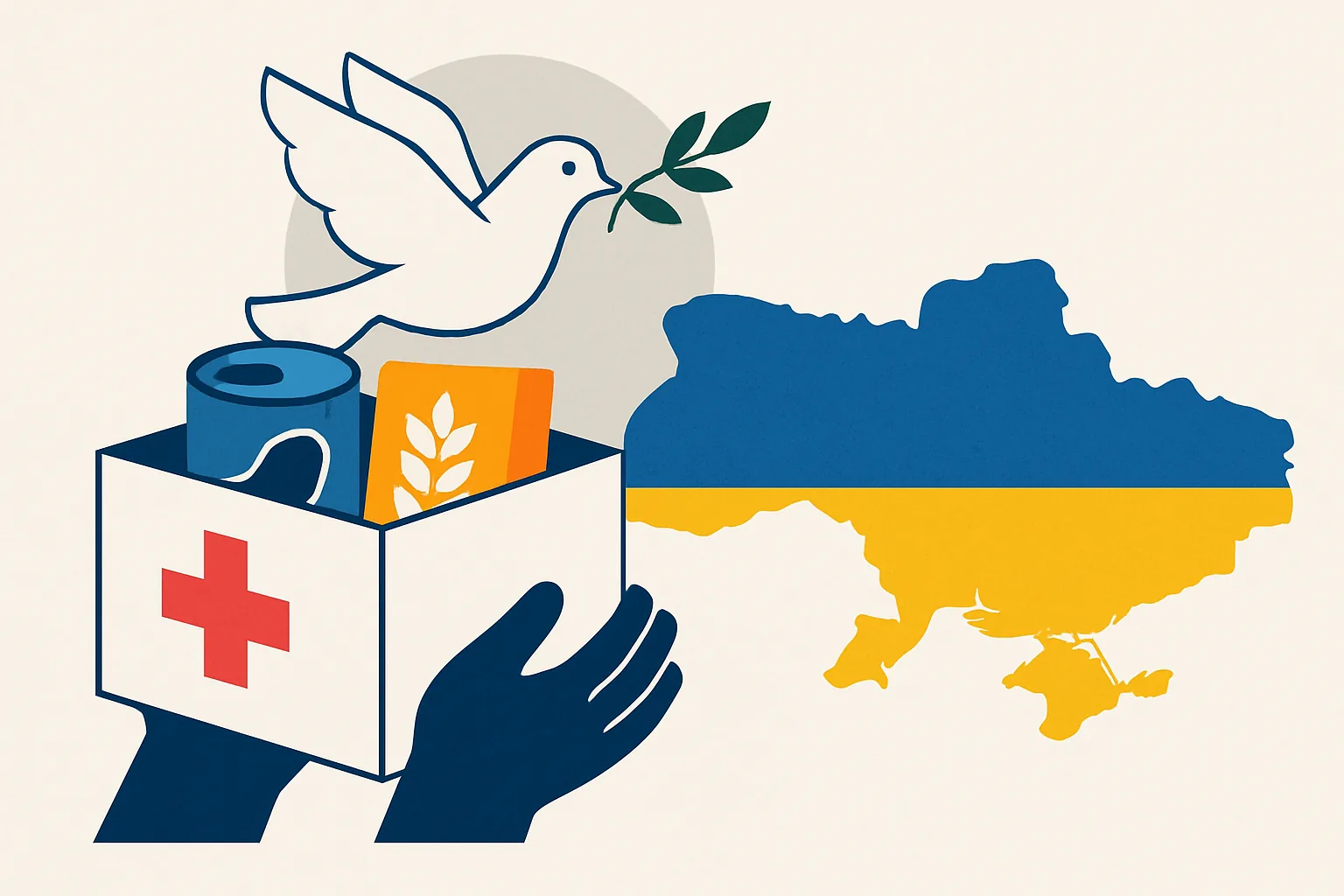
What does international aid to Ukraine mean
International aid to Ukraine is not just one stream of money or one column of trucks. It encompasses humanitarian, financial, military, medical, energy, and reconstruction support, as well as training specialists and supplying equipment. In practice, these areas often intertwine: the same program may deliver generators to a hospital, medicines to a frontline city, and funds for repairing a school roof.
There is also a practical side. When a family receives a set of products and a doctor receives supplies for dressings, this is also international aid to Ukraine, just in the most practical form. Formally, it is about supporting people, institutions, and infrastructure, rather than a beautiful declaration at a summit.
The boundaries of the concept change depending on the situation. In 2022, emergency supplies and evacuation measures were at the forefront, later programs for recovery and financial stabilization grew stronger. This is usually how it goes: one crisis requires tents, another requires transformers.
Who provides aid to Ukraine
The main donors are states, and the list is long: EU countries, the USA, the UK, Canada, Japan, Norway, and other partners. International organizations are also involved, primarily the UN and its agencies, as well as structures of the European Union, which launch specific programs for particular tasks.
There are also less noticeable participants. Funds, NGOs, church missions, city initiatives, private companies, and diasporas raise funds, purchase equipment, and organize delivery. Sometimes, a small group of volunteers can address a specific need faster than a large bureaucratic machine.
Such a set of participants is important also because international aid to Ukraine is not limited to intergovernmental agreements. One partner sends generators, another pays for the repair of substations, and a third finances mobile clinics. It turns into a mosaic, rather than a single scheme.
When looking at the informational side, it is useful to be able to distinguish real support from loud statements. For this, material will come in handy. how to check a website for fraud: against the backdrop of war, fake fundraising and counterfeit pages quickly emerge around aid.
Main areas of international assistance
Part of the support goes to the civilian population. This includes food, drinking water, clothing, hygiene kits, and temporary housing. In the cold season, heating and generating warmth are prioritized, while in summer, medications, repairing water supply systems, and assistance to those who have returned to destroyed areas are prioritized.
A separate block is assistance to internally displaced persons. People need documents, registration, places in dormitories, kindergartens, schools, and access to the labor market. When a family moves with two children and one bag, the issue starts not with work, but with a bed and a charger for the phone.
Hospitals also depend on external support. They receive equipment, consumables, mobile hospitals, ambulances, and resources to operate in conditions of power outages. In some cases, international aid to Ukraine covers even very simple things, like disposable gloves, but without them, the department does not function properly.
Infrastructure and energy go hand in hand. The repair of networks, substations, water supply, heating, and communication is happening alongside support for education, local communities, and municipalities. If a school is not heated, the academic year stalls; if a pumping station stops, the district immediately feels the consequences.
There are also recovery programs for cities and villages. They account not only for destroyed houses but also for roads, bridges, boiler houses, shelters, and administrative buildings. Sometimes one facility pulls along five others, and without it, an entire block cannot be launched.
How humanitarian support is organized
Humanitarian support operates through a chain: request — assessment — procurement — delivery — distribution — reporting. On paper, it looks dry; in reality, at every step, there are delays, checkpoints, vehicle breakdowns, or fuel shortages. Volunteers know this better than anyone.
Coordination is carried out through international structures, local administrations, charitable foundations, and partner networks. Usually, large organizations take on the distribution by regions, while local teams understand where a diesel generator is needed, where baby food is required, and where blankets are needed for evacuees.
The strong point of such a system is flexibility. The weak point is the gap between the plan and the actual road. Cargo may arrive in the city but not reach the village; medications may sit in a warehouse while paperwork is processed; help exists, but access to it does not. This is where the cost of coordination becomes apparent.
Volunteer and charitable programs fill in the short gaps that large organizations fail to notice. Sometimes they start with three boxes, and within a month, they are already managing a warehouse, sorting, and distributing to specific addresses. The human scale is particularly clear here.
For those who want to take a break with something light between news and reports, the site has jokes about students. Jokes for free. Short. It's a small pause, but sometimes it's needed too.
Financial and macroeconomic support
Financial assistance goes not only to the accounts of ministries. It helps cover budget deficits, maintain social payments, pay salaries in critical sectors, and support the functioning of government institutions. Without this, even a strong administrative system quickly runs into a cash gap.
Macroeconomic support is important at times when incomes fall and expenses rise. The government needs to pay teachers, doctors, rescuers, and military personnel, repair networks, and provide basic services. When the tax base shrinks due to war, external revenues become the bridge between today and the future budget.
Part of the funds goes to recovery programs. These are grants, concessional loans, insurance mechanisms, and guarantees for investors. The simple logic here is this: if an area is destroyed, private business will not come on its own until it sees roads, light, and some predictability.
Financial support also affects trust in government institutions. If pensions arrive on time and the hospital receives payment for services, people have fewer reasons to panic. Conversely, a 5-day delay is often perceived more strongly than official statements of 50 pages.
Military and defense assistance: an overview
Military assistance is a separate block of international aid to Ukraine, and it is discussed with particular caution. In the public domain, the focus is usually on training, equipment, logistics, communications, medical evacuation, and demining. Details of supplies in open sources are often limited for understandable reasons.
Training personnel helps to quickly master complex equipment and coordinate actions between units and partners. Logistics is no less important: even a good resource is useless if it hasn't reached the right destination. Communication, repair, and maintenance often turn out to be not secondary, but primary.
Demining is a separate topic. It is related to both the safety of people and agriculture, as well as the return to normal life in liberated areas. One field can feed a village, but only after being checked by sapper teams.
For readers who are interested not only in news but also in lighter materials, the site has text the most brutal experiments of psychologists. The link is appropriate as an example of how serious and entertainment topics coexist on megainet.art.
Problems, risks, and limitations of international aid
The first problem is coordination among donors. When 10 partners are helping one area, without a common map, it's easy to get duplication in one spot and failure in another. One warehouse is overflowing while the neighboring one is empty. This happens too.
The second problem is transparency in distribution. Donors want to see where the aid went, while recipients expect it to be delivered without losses and delays. For this, reports, audits, cargo labeling, and clear procurement rules are needed. Formality here is not an embellishment, but a protection against chaos.
The third problem is bureaucracy. If approval for one shipment takes too long, the aid loses its meaning precisely at the moment of acute need. War does not wait for paperwork, and this is one of the most painful things.
There is also logistics. Destroyed roads, power outages, fuel shortages, the risk of shelling, and seasonal weather can disrupt deliveries. One truck gets stuck in the mud, and the entire chain is delayed. No romance, just schedules and wheels.
The needs on the ground are also changing rapidly. Today we need bread, tomorrow - a pump, the day after tomorrow - building materials, and in a week - school desks. Therefore, international aid to Ukraine requires constant adjustment, not a one-time shipment of goods.
Results: why international aid to Ukraine is important
International aid to Ukraine is important not only as a response to the crisis. It supports people living in wartime conditions, sustains hospitals, schools, and public services, and also provides the state with the resources to avoid collapse under pressure. Without external support, too much would have to be closed manually and with losses.
For the country's recovery, it is not just one gesture that matters, but a sequence of steps: humanitarian support, financial stabilization, infrastructure repair, protection of critical facilities, and working with local communities. In the long run, it is this combination that helps return to normal life, rather than its imitation.
And one more practical detail: when help comes from dozens of partners, an ordinary person must also maintain critical thinking. Checking sources, documents, and fundraising pages saves money, time, and nerves. There are no small details here.
In reality, international aid to Ukraine is not a beautiful slogan, but a daily job with numbers, routes, warehouses, and people, and it is precisely in this that it maintains the country's resilience.