How to check a website for an offline store
How to check a website for an offline store
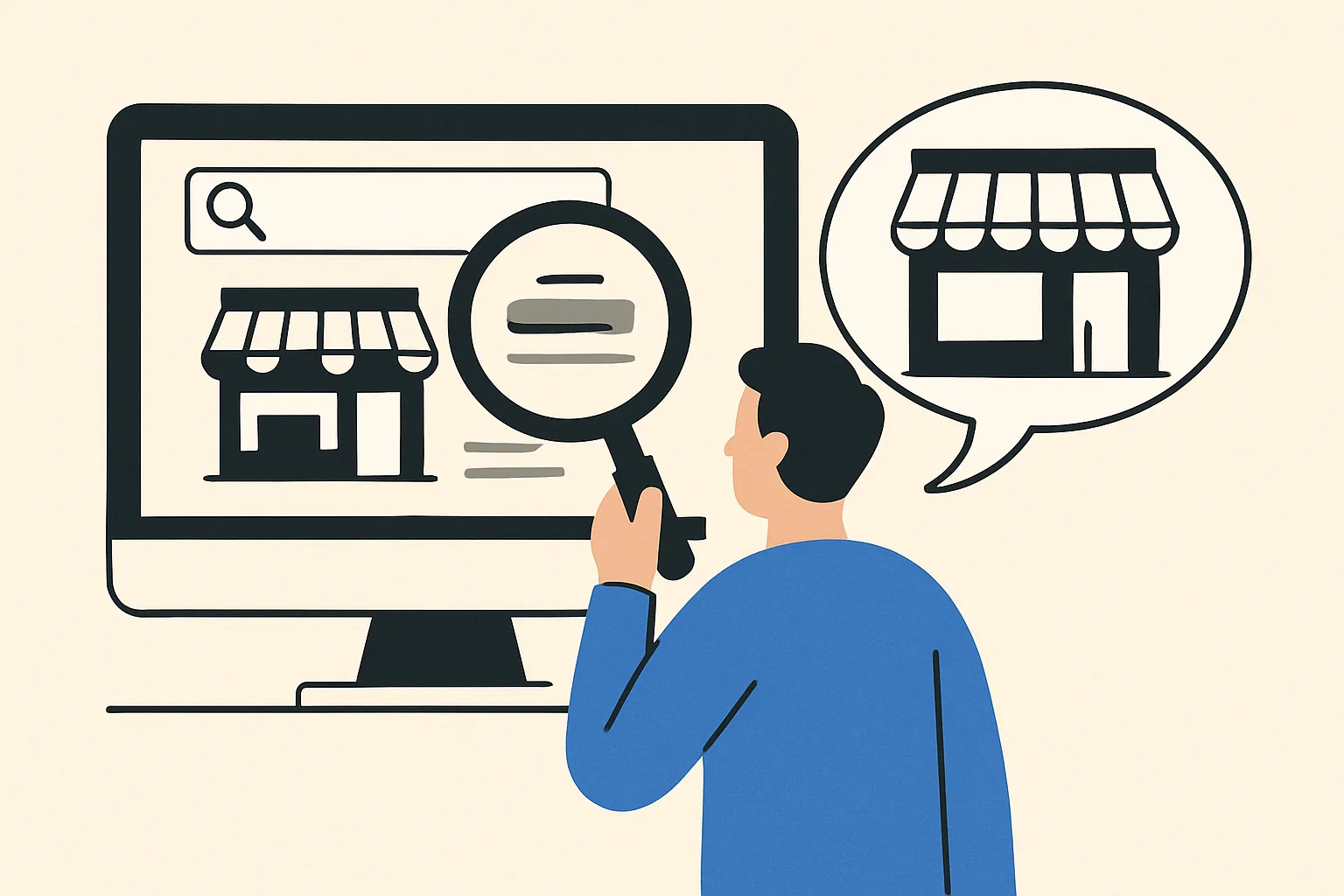
If the site sells sneakers, kettles, or spare parts, a beautiful catalog is not enough. Verification is needed. Otherwise, it's easy to mistake a one-day store page for a real shop, where there is no display, no cash register, and no people at the counter.
It's useful to keep a simple criterion in mind: a real offline store usually leaves traces. Address, phone number, working hours, photos of the entrance, map, details, mentions in directories. One sign proves nothing, but 3-4 matches provide grounds for a conclusion.
Below we will discuss how to check a site for the presence of an offline store without unnecessary theory and without blind faith in a beautiful footer. Sometimes a site looks convincing, but then it turns out that the address is a coworking space, and the phone only responds in a messenger.
1. What the presence of an offline store means for a site
An offline store is not just a legal entity in documents. It is a place you can physically go to: a sales floor, showroom, pickup point, or service location. For the customer, the difference is immediately noticeable, especially if a return, fitting, or personal inspection of the product is needed.
An online project without a physical location usually has less specificity. There may only be an order form, email, and a 'Buy' button. A store with a physical presence often has business hours, a map, and a phrase like 'we look forward to seeing you at' — with the house number, floor, entrance, or landmark. If 'sales office' is mentioned, that's already a sign, but it still needs to be verified.
In practice, people are looking for not an abstract status, but a clear answer: can they come in person, see the product, and pick it up without a courier? This is especially important for electronics, furniture, and clothing. Too many promises on the website is a bad sign. One honest address is worth more than ten advertising slogans.
2. Verification of contacts and address on the website
Start with the contact section. This is where the phone number, address, email, map, and details are usually hidden. If the site only has a feedback form, that's already a reason to be cautious. A phone number with an area code, a landline number, and a clear working schedule look more convincing than just a mobile number that doesn't answer after 6 PM.
The address should be taken literally. Not 'city center', but street, house, office, floor. When it says 'near the metro' or 'next to the shopping center', that's a weak signal. A good sign is the presence of detailed instructions: 'entrance from the yard', '2nd floor', 'next to the pharmacy'. Such details are usually not made up for aesthetics, but because the location actually exists.
Also, look at the route map. If it's embedded, open it and check if the point matches the address on the site. Sometimes the map leads to a neighboring building or an empty spot on the diagram. In such cases, it's useful to switch to external verification. And yes, an address in an image without text is almost useless: it can't be copied or verified.
There is also a simple household test. Call and ask 2 questions: can you pick it up yourself and is the location open on Saturday? The answers should sound confident and match the information on the website. If you are promised to 'call back later' three times in a row, trust decreases. One answer is better than three pauses.
3. Analysis of the 'About Us', 'Delivery', 'Payment', and 'Contacts' sections
The 'About Us' section often reveals more than it seems. You can find mentions of a warehouse, showroom, office, pickup point, company brand, and years in operation. If the text is too general, without names, addresses, and history, it confirms nothing. A real store usually isn't afraid to name itself specifically.
In 'Delivery', look for self-pickup, order pickup window, and hours when the product can be collected without a courier. In 'Payment', useful phrases include cash register, terminal, cash payment on site, payment upon receipt. An online store without offline presence often only has online acquiring and payment via link. The absence of self-pickup is not a death sentence, but it is a minus for the offline version.
The 'Contacts' section often shows how much the site cares about verifiability. There may be several phone numbers, sales department email, messenger, directions, and working hours. If you see the phrase 'from 10:00 to 19:00 without weekends', and there is no address nearby, this is a half picture. In an offline store, contact details usually do not exist in a vacuum.
Sometimes it is useful to compare the presentation of the text. When one place says 'store', another says 'online platform', and a third says 'product selection service', the question arises about what exactly you are facing. Inconsistency in wording does not prove deception, but shows that the site was assembled without discipline. And discipline in trade becomes apparent quickly.
If you want to take a break from the dry check, you can open jokes about students. Jokes for free. Short. Just not for long — then you'll have to return to contacts and addresses anyway.
4. Searching for an organization in maps and directories
The next step is maps and directories. Enter the website name, brand name, and phone number into Yandex.Maps, Google Maps, and local directories. Look for not only exact matches but also variations in spelling. Sometimes a store is listed as LLC 'Alpha', while the website displays a storefront 'Alpha Shop'.
In the organization's card, 4 things are useful: address, category, working hours, and reviews. If the card exists but there are no reviews at all, it's not a disaster. However, if the website indicates a retail space, but the maps show a residential building at that address without a sign, questions arise. Another alarming sign is a very new card without history and photos.
Match the details. The name matches, the phone number matches, the address matches — good. If only the name matches, but the phone number is different and the website is different, that's a reason to dig deeper. Maps are not perfect, but they quickly catch gross discrepancies. And it is these gross discrepancies that often reveal a fake point.
It's useful to look at photos on maps. Signage, entrance, cash register, display window, pickup counter — all these are real signs of offline presence. A photo of an empty facade without markings means nothing. Sometimes a website shows a beautiful interior, but the maps for that address show a different store or even a warehouse. There's really nothing to argue about here.
5. Verification of legal information and details
Legal data is the boring part, but it's essential. TIN, OGRN, company name, legal address, bank account — all of this can be checked in open sources and registries. If this information is missing from the website, that's already a weak point. If it exists but doesn't match, trust decreases even more.
Check the company name precisely. One extra letter, a different city, another registration address — these seem like small details at first glance. Honest stores usually have accurate matches. In questionable projects, the details are often inserted haphazardly, as if they were added at the last moment before launching the landing page.
It is useful to check who the domain is registered to and who is listed in the public company records. If the site talks about a large store in the city center, but the legal address is in a small space on the outskirts, it is not a death sentence. But the question remains. And there should be more than one or two such questions.
When the details match, it's not the end. Documents can be easily copied. The point is different: genuine details usually leave traces in other sources, rather than hanging alone. If you only have a pretty page with numbers, that's not enough.
6. Comparison of domain, brand, and company data
Now compare the domain, brand, and company information on social media. For example, the website lists one name, VK has another, and the organization card shows a third. Such discrepancies do not always indicate fraud, but they almost always suggest confusion. A physical store usually keeps a consistent name, at least in 2-3 main channels.
Pay attention to publication dates, the logic of updates, and the style of communication. If the website looks active, but the social media has been abandoned for 8 months, that's not a good sign. Sometimes the offline location is actually operating, but the marketing is asleep. In that case, it's worth calling and clarifying the details manually, rather than drawing conclusions from one empty profile.
It is useful to check if another legal entity is hiding under a well-known brand. This happens with franchises and intermediaries. The website has one logo, the contract has a different company name, and in the reviews, people mention a third address. Too many layers — it's already a risk.
If you come across an article how to check a website for fraud, it is worth reading it along with this check. The logic is similar: we look for inconsistencies, rather than believing the first screen.
7. Indirect signs of a real offline store
Indirect signs often resolve disputes. These include pickup options, working photos of the interior, storefront, warehouse, order acceptance schedule, and live customer reviews. If people write that they 'picked it up on site', 'tried it on in the hall', or 'exchanged the product at the counter', this is a good signal. One such review doesn't save, but 5-6 similar ones say a lot.
Look at the photos critically. Stock images can be taken in 10 minutes, while real photos of the location are harder to fake. Authentic photos often show repeating details: the same wall, cash register, door, counter, room number. If all the photos seem to come from different catalogs, it's worth being cautious.
Mentions in external sources are also important. Local media, city forums, maps, aggregators, reviews on platforms — all of this creates a footprint. A store that is genuinely operational rarely remains completely without external noise. Conversely, too sterile a silence around sales raises suspicions.
For a break, you can watch The human body. Numbers and facts. Interesting. But then return to the reviews: they sometimes reveal the details that the site tries to hide.
8. What to do if the data contradicts each other
If the address exists but the maps do not recognize it, start by rechecking the company name and phone number. If the details match but the photos and reviews are empty, call and ask to confirm the working hours, pickup, and entrance. If the phone responds evasively, that is already an answer. Not ideal, but an answer.
A good working algorithm takes 4 steps: 1) find contacts on the site, 2) verify the address on the maps, 3) check the details, 4) compare this with reviews and photos. When at least 2 sources confirm each other, you can speak about a real point with greater confidence. When there are no confirmations, it's better not to rush with the prepayment.
A strong contradiction is a reason to stop. For example, the website promises a store with a showroom, but the registries and maps indicate an office without customer service. Or the website lists one address, while reviews consistently mention another. Such discrepancies should not be 'interpreted' in favor of the store. Verification is precisely needed to avoid assumptions.
If doubts remain, call again and ask one direct question: 'Can I come today and pick up the order in person?' An answer with the address, time, and entrance usually clarifies a lot. If instead you are only offered correspondence in a messenger, be cautious in trusting. This is where verification ends, not where belief begins.