Microsoft announced Project Zenith: lightweight Windows for powerful AI development
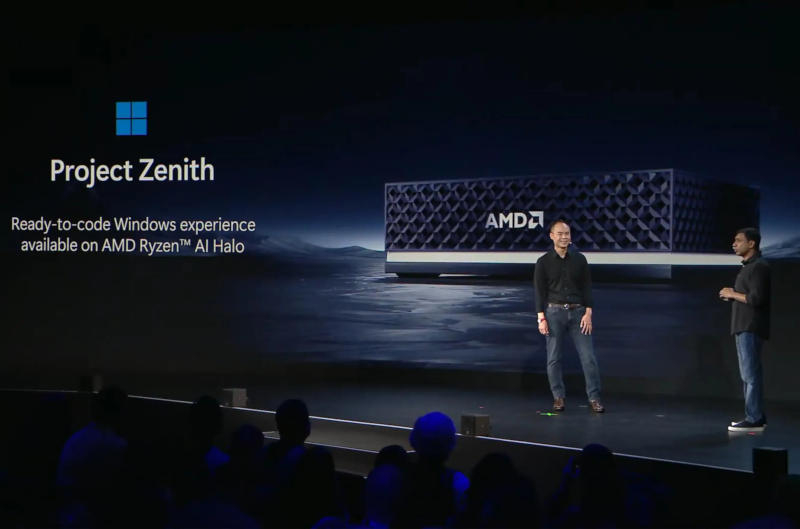
- Project Zenith is a lightweight Windows for AI developers.
- Support for models with over 30 billion parameters locally.
- The AMD Ryzen AI Halo mini-PC was showcased at IFA 2026.
- At least 64 GB of memory, with a bandwidth of 250 GB/s.
Microsoft announced the launch of Project Zenith — a specially tailored version of the Windows operating system aimed at powerful workstations used by software developers and AI models. According to Logan Iyer, Vice President of Windows Platforms and Development, such machines allow running models with over 30 billion parameters without limitations, accelerating experimental work and reducing the need to rely on cloud token limits.
Specifications and requirements
To operate within Project Zenith, devices must be equipped with at least 64 GB of unified memory with a bandwidth of at least 250 GB/s. These parameters provide sufficient volume and speed of data access to locally execute large neural network models that previously required expensive servers.
The first prototype presented by AMD at the IFA 2026 exhibition is a compact PC based on the Ryzen AI Halo processor. Additional solutions are planned for release in the coming months, including those on other architectures, which will expand the options for developers.
Set of pre-installed tools
The system comes with a ready-made set of programs, including Visual Studio Code, GitHub Copilot, PowerToys, WinAppCLI, and Windows Dev Skills. Windows Explorer is configured to immediately show file extensions, hidden items, and the full path to the object, while distracting features such as the recent files list, sync suggestions, Start menu suggestions, and account notifications are disabled. The PowerToys command palette is enabled by default, making it easier to quickly access frequently used commands.
These changes, according to Ayer, reflect the requests of the developer community: 'We listened to those who create software products and tried to remove everything that distracts from focusing on work.' He emphasizes that the development of AI is changing the approach to coding, and Windows must evolve alongside this process.
The project is aimed not only at large corporations but also at independent developers, including those from countries where access to cloud resources is limited. The ability to run heavy models locally may become an important factor for Ukrainian IT teams, who often have to work under conditions of limited infrastructure.
Microsoft plans to expand the Project Zenith lineup by adding new processor models and improving integration with cloud services when truly necessary. Thus, the platform is expected to become a flexible bridge between local computing and scalable cloud solutions.
Source: 3DNews