ESA confirmed the completion of the BepiColombo probe's flight to Mercury
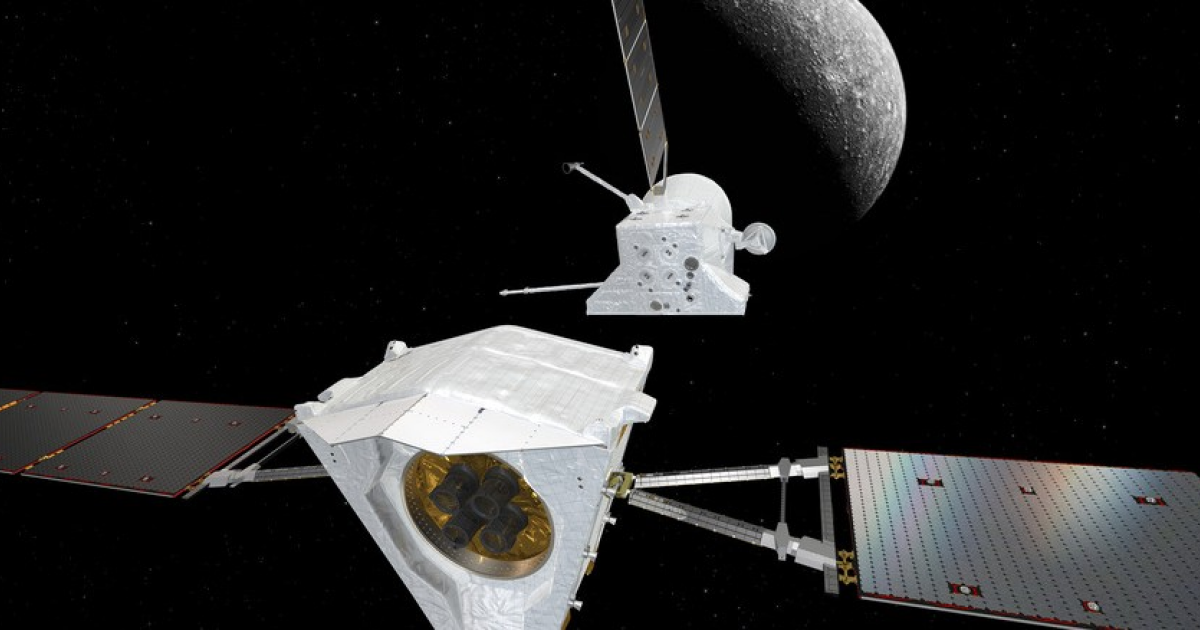
- ESA recorded the separation of the MPO and MMO probes from the MTM on September 3, 2026.
- The flight to Mercury lasted almost eight years and included nine gravity assists.
- The planet's orbital insertion is scheduled for November 2026, with scientific experiments starting in April 2027.
On September 3, 2026, at 16:54 Moscow time, the European Space Agency (ESA) received confirmation that the European MPO probe module and the Japanese MMO probe module had separated from the MTM transfer module. This event marked the end of the long flight phase of the BepiColombo interplanetary station to Mercury.
A long journey to the closest planet to the Sun
The flight, which began after the mission's launch in October 2021, lasted almost eight years. During this time, the spacecraft performed nine gravity assists – three at Earth, three at Venus, and three at Mercury itself. These maneuvers were used to accelerate and adjust the trajectory without using fuel, allowing the required speed for entering the planet's orbit to be achieved.
In addition to the planned gravitational assists, the team encountered issues with the propulsion system, which required adjustments to the mission schedule. Engineers conducted additional checks and made changes to the flight plan, but the main course to Mercury was maintained.
Upcoming mission stages
According to the current plan, on November 21, 2026, the MPO and MMO probes will enter primary orbit around Mercury. In early September of the same year, the European module MPO will separate from the Japanese probe MMO along with the sunshield, after which MPO will continue its journey to its operational orbit, which is expected to be reached by March 2027.
The scientific program of the station is scheduled for early April 2027. It will involve a detailed study of the planet's magnetic field, its internal structure, surface composition, and thin exosphere, as well as the processes related to solar wind interaction.
The significance of the mission for science
BepiColombo is the first joint European-Japanese interplanetary mission, and its results could significantly expand our understanding of the formation of terrestrial planets. Mercury, being the closest body to the Sun, remains the least studied, and the data obtained will help refine models of the early history of the Solar System.
The mission also demonstrates the effectiveness of international cooperation in space research, combining the resources and expertise of ESA and JAXA. A successful insertion into orbit will be an important milestone confirming the readiness of modern space technologies for long and complex flights.
Source: N+1