Voyager 1 is approaching the milestone of being one light-day from Earth
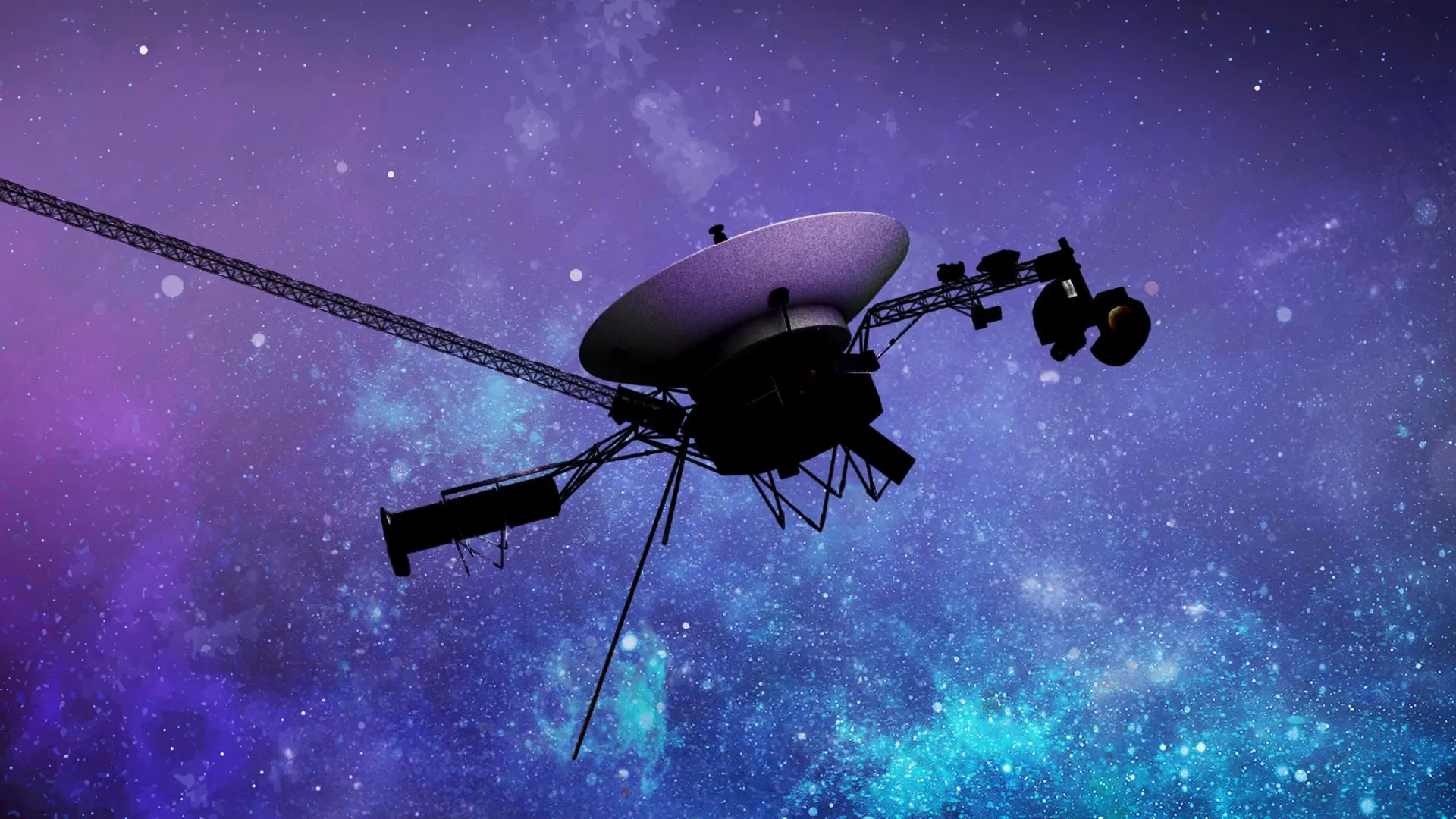
- On November 18, Voyager 1 is expected to reach a distance of 16.09 billion miles from Earth—one light-day
- In September, engineers replaced three devices with less power-hungry ones to extend the operation of the remaining science instruments
- After a communications outage on October 18–19, the signal returned on October 20; the cause of the incident has not yet been determined
The distance at which waiting for a response takes two days
Voyager 1 is approaching a milestone that vividly illustrates the scale of its journey: on November 18, the spacecraft is expected to be 16.09 billion miles, or 25.89 billion kilometers, from Earth. Light takes 24 hours to travel that distance, which is why it is called one light-day. No other human-made object has ever traveled so far. For NASA, this is not only a symbolic date, but also a reminder of the extremely slow communication with the probe.
Voyager 1 is traveling through interstellar space at about 38,000 miles per hour, or 61,155 kilometers per hour. Despite this motion, the spacecraft cannot exchange data with Earth quickly: radio signals travel at the speed of light, and a command takes about a day to reach the probe. The return signal takes about another 24 hours. So even when communications are working, about two days pass between sending a command and receiving a response.
The probe left Earth in 1977 and has spent nearly five decades in space. It and Voyager 2 crossed the boundary of the heliosphere — a vast region of particles and magnetic fields created by the Sun — and entered interstellar space. These spacecraft remain the only ones to have directly explored the environment beyond the heliosphere. Their measurements are therefore important not only as a continuation of a long-running mission: there are currently no other missions capable of collecting data in this remote region.
Saving power on a spacecraft nearing its half-century mark
In September, the Voyager team completed an operation to reduce the spacecraft’s power consumption. Engineers replaced three devices with alternatives that require less electricity; three other devices help maintain the right temperature. The work was unofficially dubbed the “Big Bang” and required several months of preparation. The replacements were made at the same time to reduce power consumption while maintaining the proper distribution of heat inside the probe despite the extreme cold of space.
This sequence of actions was necessary because of how the heating system is designed: all six devices involved help maintain the temperature inside the spacecraft. According to NASA, the three original components had to be replaced together, rather than individually, to avoid disrupting the thermal balance. The operation on Voyager 1 was carried out about six weeks after a similar procedure on Voyager 2. NASA expects the upgrade to extend the operating life of Voyager 1’s remaining science instruments and allow it to continue gathering data from interstellar space for longer.
Both probes get their electricity from radioisotope thermoelectric generators. These use heat released by the radioactive decay of plutonium and convert it into electrical energy. As this process continues, the probes’ available power decreases: each loses about four watts of output per year. After nearly 50 years, this gradual decline has left engineers with very little margin. NASA has already switched off equipment that is no longer needed for the current phase of the mission in order to keep the remaining systems running.
Loss of communication and automatic switchover to backup
When Voyager 1 launched in 1977, it carried ten scientific instruments. Some were switched off after the spacecraft completed its flybys of the outer planets, while others continued exploring increasingly distant regions of space. Its limited power supply has already forced NASA to turn off two scientific instruments in recent years. Against this backdrop, preserving the remaining instruments is practically important: they make it possible to continue direct observations of the environment beyond the heliosphere, where no other spacecraft have yet been sent to take measurements.
Before carrying out the “Big Bang,” NASA could have faced the need to turn off another Voyager 1 instrument as early as summer 2027. Successful power savings should push that prospect further into the future, but the source does not claim that the upgrade guarantees all the instruments will keep working until a specific date. The generators continue to lose power, and a spacecraft that is nearly fifty years old could encounter new technical difficulties. The aim, therefore, is to extend the mission’s capabilities, not to eliminate the limitations imposed by its power supply.
Meanwhile, engineers are investigating a communications outage that occurred on October 18 and 19. During two scheduled sessions, 24 hours apart, the Deep Space Network did not receive a radio signal from Voyager 1. After two unsuccessful attempts, the signal unexpectedly reappeared on October 20—about 48 hours after the outage began. According to NASA, communications have been maintained ever since, and specialists have sent commands to the spacecraft to investigate what happened.
What the one-light-day milestone means
The Deep Space Network is a system of large radio antennas located at three sites around the world. It enables NASA to exchange signals with spacecraft operating near the Moon and much farther away. During the incident, Voyager 1 was about 16 billion miles, or 24 billion kilometers, from Earth. The source does not specify what caused the signal to be absent during the two sessions. Therefore, the restoration of contact cannot yet be considered a definitive explanation for the outage.
During a check, engineers discovered that one set of Voyager 1’s attitude thrusters had stopped working, after which the spacecraft automatically switched to its backup thrusters. The switch is part of the fault protection system: onboard computers can detect a potential problem, switch to backup equipment, stabilize the spacecraft, and pause routine operations. This gives the ground team time to assess the probe’s condition and decide what to do next. However, NASA has not yet determined whether this particular malfunction caused the loss of communication.
Voyager mission manager Karim Badaruddin of NASA’s Jet Propulsion Laboratory noted that this was the first time the team had seen the spacecraft behave this way, but that at this stage of the mission, unexpected events are to be expected. He also expressed relief that communication had been restored and a desire to understand what had happened. The next major milestone—the expected crossing of the one-light-day distance on November 18—does not resolve this uncertainty: the probe continues to operate, but its power is limited, and the investigation into the incident is still ongoing.
Source: ScienceDaily