Starlink satellites have become a global barometer of Earth's atmosphere
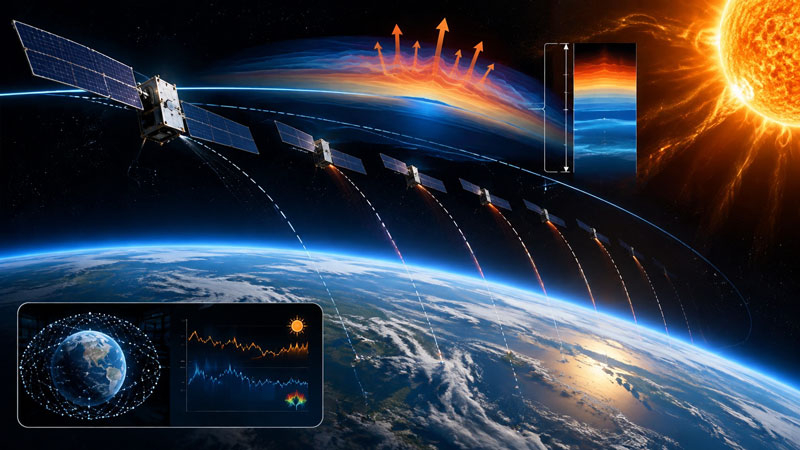
- Low Earth orbit satellites measure thermosphere density through the parameter B*
- Changes in B* correlate with the solar radio flux at 10.7 cm
- About 2000 satellites from different constellations are involved in observations
- The method helps improve space weather forecasts
Tony Phillips, a renowned astronomer and science communicator, proposed the idea of transforming satellites of megaconstellations in low Earth orbit into a kind of global sensor for the state of the upper atmosphere. The method is based on open orbital datasets TLE published by the U.S. Space Command, which include the parameter B* – a coefficient reflecting atmospheric resistance.
When moving in space, any object encounters rare, but still existing air. The denser the gas at an altitude of several hundred kilometers, the stronger the deceleration and the faster the satellite loses altitude. If the actual density of the atmosphere exceeds the predicted model, the orbital calculation adjusts B*, increasing its value. Thus, the change in B* becomes an indirect indicator of air density in the satellite's orbit and is available to every user.
Solar activity plays a key role in this process. An increase in ultraviolet radiation heats the thermosphere – a layer from 90 to 600 km – causing it to expand. The expanded gas creates stronger resistance, and the orbits of satellites begin to fall faster. According to Phillips, the rate of descent correlates with the solar radio flux at a wavelength of 10.7 cm, and the atmospheric response is observed about two days after a change in solar activity.
In addition, geomagnetic storms caused by solar flares can lead to sharp and short-term increases in atmospheric density. Such events result in an immediate acceleration of orbital decay, which is also reflected in changes in B*.
To test the hypothesis, the researcher included not only Starlink satellites in the analysis but also other large constellations: about 1000 Starlink devices, 107 Planet Labs SuperDove satellites, 391 Amazon Kuiper satellites, and 651 Eutelsat OneWeb satellites. The different altitudes of their orbits allow for the comparison of the response of different layers of the thermosphere, turning the network into a distributed weather station without the need to launch new scientific missions.
Limitations and prospects
The method has a number of limitations. Some satellites perform orbital corrections, change orientation, or activate engines, which can distort the data. Additionally, the accuracy of TLE is lower than that of specialized measuring instruments. Nevertheless, the large volume of observations allows for statistical separation of individual anomalies from general trends.
Taking these features into account, such a 'barometer' is capable of improving space weather models, increasing the accuracy of collision and satellite degradation risk assessments, and expanding our knowledge of how the upper layers of the atmosphere respond to solar and geomagnetic disturbances.
Source: 3DNews