How to check a website for reviews and contacts: step-by-step guide
How to check a website for reviews and contacts: step-by-step guide
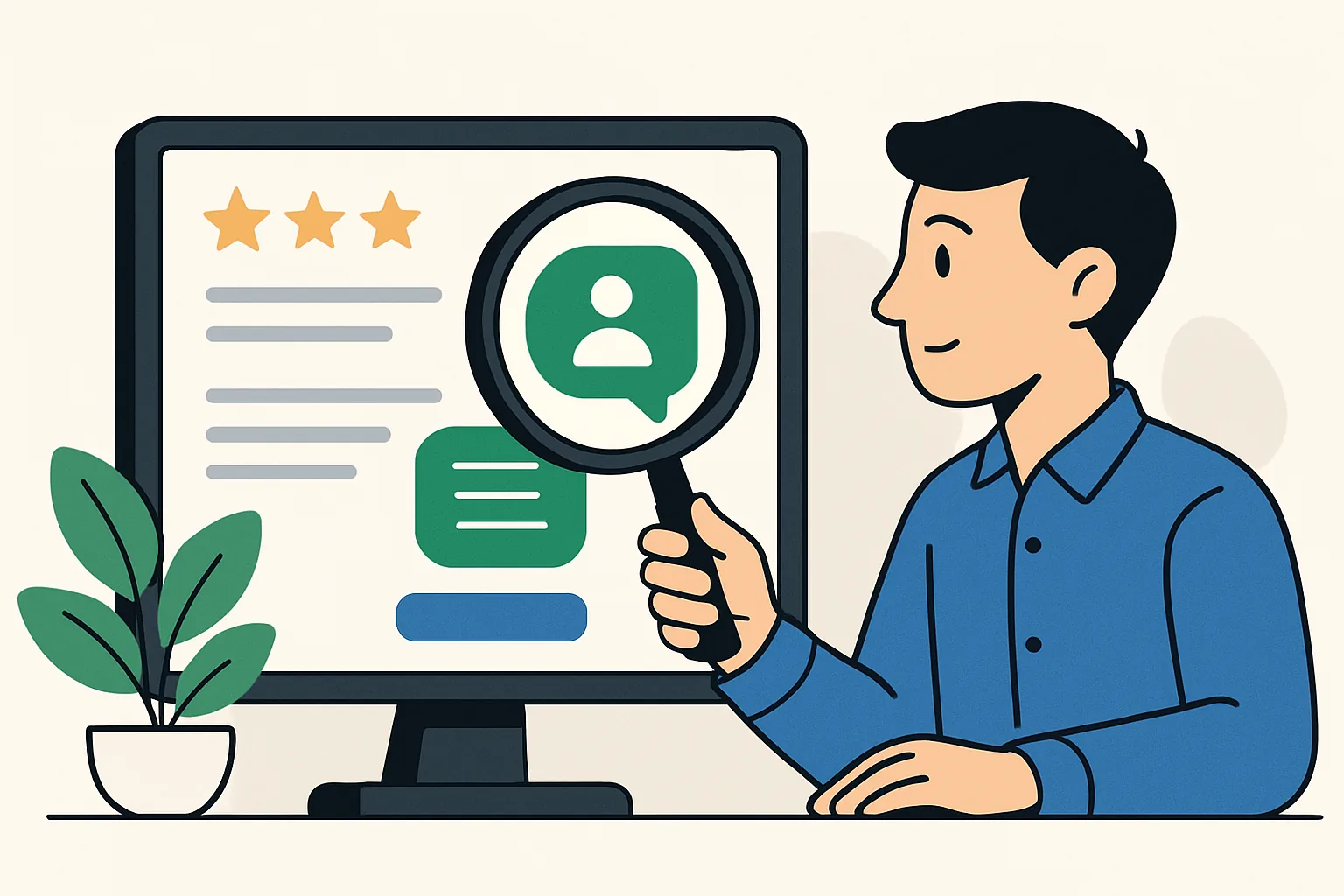
Before entering your card number, leaving an email, or especially placing an order, it's useful to pause and take a closer look at the website. There's no magic here: a reliable project usually does not hide. It has clear contacts, coherent reviews, details, a privacy policy, and traces of active work. In contrast, suspicious sites often have all this poorly arranged or completely absent.
Checking a website for reviews and contacts takes a little time, but often saves money, nerves, and personal data. Especially when it comes to purchasing from a new online store, ordering a service, or registering on an unfamiliar platform. By the way, if you need a separate analysis specifically for stores, you will also find a step-by-step check of the online store for reviews.
1. Quick website check before starting
It's better to start not with reading long reviews, but with a short preliminary inspection. It's like looking at a storefront before entering a store: you can understand a lot from the first details.
First, check if the website has:
- a 'Contacts' or 'About Us' section;
- a phone number and email address;
- a physical address of the company, if applicable to the business;
- legal entity or individual entrepreneur details;
- links to social media;
- privacy policy and user agreement;
- a clear description of the product, service, or work process.
If instead you only see bright buttons saying 'Buy Now', 'Discount Only Today', and general promises without specifics, that's already a reason to slow down. A self-respecting website usually does not hide basic information. It understands that trust begins with transparency.
Another quick indicator is the domain. Sometimes just by the website's address, you can see that it was registered recently, looks random, or copies a well-known brand with a slight difference in the name. This is not always a verdict, but a reason to be cautious.
2. Where to look for reviews about the website and how to distinguish real ones from fake ones
It's better to gather reviews not from one place, but from several sources. One enthusiastic comment on the website itself proves nothing. Ten identical 'everything is great, I recommend' also do not convince. A general picture is needed.
Where to look for reviews:
- search by the website or company name in search engines;
- maps and services with organization cards;
- social networks and comments under posts;
- forums, thematic communities, and independent platforms;
- review sites where users share experiences without direct seller moderation.
It's better to make diverse queries: website name, company name, phone number, domain, phrases like 'reviews', 'scammers', 'fraud', 'order not received'. Sometimes it's useful to search by exact domain, and sometimes by details if they are provided.
How to distinguish real reviews from fake ones? A genuine review usually has details. The person writes about what exactly they ordered, how quickly they received a response, what they liked or didn't like. The text may include small everyday observations: 'the manager replied in the evening', 'the courier called in advance', 'they refunded the money in two days'. This does not resemble a faceless advertising template.
Fake reviews often present themselves differently:
- too general text without specifics;
- the same style among different authors;
- the same phrases, as if written from a template;
- a lot of enthusiasm without a single detail;
- a sharp spike in reviews over a short period;
- reviews are either only positive or equally negative;
- author profiles are empty, new, or look like disposable ones.
The most reliable assessment looks not like a perfect score, but rather a normal, lively range of opinions: some are satisfied, some criticize the delivery, and some praise the support. A complete lack of criticism can be suspicious. The world rarely operates that smoothly.
If you want to delve deeper into the approach to evaluating platforms, it is useful to see how to check a website for reviews — it complements practical verification before payment.
3. How to check the website's contacts and get in touch with the company
Contacts are one of the simplest yet most telling elements. If a company is truly operational, it usually does not limit itself to just one anonymous feedback form without a responsible person.
What should raise immediate concerns:
- the phone does not answer or drops the call;
- the email does not exist or messages bounce back;
- the address is provided, but there is no company at that location;
- messengers do not respond immediately and only with template phrases;
- there is a feedback form, but no response comes.
Checking the phone starts simply: call during business hours and ask a specific question. Not 'do you even exist?', but something more natural: how to place an order, how to return a product, how delivery works. A normal response usually sounds confident and does not contradict the text on the website.
Email should also be tested. It's a good sign if the email comes not only technically but also substantively. A bad sign is if responses come from a different address, without a signature, with gross errors, or if the email looks like it was generated hastily. However, one typo doesn't say much. The overall impression is what matters.
The company's address can be checked through maps, directories, and mentions in searches. If an office is listed but is not on the maps, and reviews indicate that a completely different organization is at that location, this is a warning sign. For online stores, the absence of an office is not always a problem, but then especially important are the details, clear ways to contact, and transparent delivery.
It's good if the site provides multiple channels of communication, rather than just one. Reliability usually increases where you can message, call, send an email, and get a response on the site. If the only contact is a single 'write to us' button, and no one responds, there is little trust.
4. Checking the site for fraud: obvious signs of risk
Checking the site for fraud starts with carefully reading the text. Scammers often rush and reveal themselves through inconsistencies. At first glance, it's a small detail, but it's these small details that create the real picture.
What to look for first:
- too good to be true promises without explanation of the terms;
- aggressive calls to pay immediately;
- timers and 'last spots' that update endlessly;
- different company names in different sections of the website;
- errors in the text, especially in important legal blocks;
- copied photos and other people's logos;
- fake certificates, diplomas, licenses, or document scans;
- hidden return and delivery conditions.
Special attention should be paid to documents. If the website promises licenses, certificates, or official representation, it's better to double-check the documents. Often, images are posted without numbers, without dates, and without the possibility to verify their authenticity. Sometimes the name of the organization on the document does not match the name on the website — and this is already a serious reason to stop.
Another alarming sign is strange sales logic. For example, the website offers to buy an expensive product only with full prepayment, but does not provide any guarantees, does not show real reviews, and hides the address. Or it promises incredible returns but does not explain how they are achieved. When promises sound too good to be true, it's useful to remember the old rule: if the terms are unclear, they may turn out to be unfavorable.
Sometimes a fraudulent project disguises itself as a completely ordinary online store. Therefore, it is useful to compare not only texts but also visual details: identical photos on different pages, different styles in product cards, fluctuating prices, non-functioning sections. For interest, one can compare this to how a truly well-thought-out presentation of material looks, for example, in collections like material about facts and figures about the human body — there the structure is immediately noticeable, and this is not a coincidence.
5. Checking the reliability of the website through technical and legal data
If the surface check did not reveal any obvious problems, move on to the calmer but important part — the technical and legal details. These often show how much the website actually exists as a real business, rather than just a temporary showcase.
It is useful to check:
| What to look for | Why is it needed |
|---|---|
| Domain | Understanding the age and history of the website |
| SSL certificate | Protects data transmission, but does not guarantee reliability by itself |
| Owner and contacts | Help understand if there is a real company behind the website |
| Privacy policy | Shows how personal data is processed |
| Offer or terms of use | Contains rules for payment, returns, and responsibilities of the parties |
| Company details | Allow verification of the legal entity with external sources |
It is important to understand: the presence of a lock in the address bar does not make the site trustworthy. An SSL certificate is just a connection protection. Fraudsters can have it too. Therefore, one should not limit themselves to checking the security icon.
Legal pages should not be read diagonally. Yes, it is more boring than flipping through product cards. But this is often where unpleasant surprises hide: strict return policies, liability limitations, hidden fees, automatic subscriptions. If the privacy policy or offer is written formally, without specifics, it is a weak sign of reliability.
The age of the domain and the history of changes help to see if the site suddenly appeared under a new brand. If the site claims many years of experience, but the domain is quite young, it is worth asking questions. It is not necessary to close the page immediately, but definitely do not rush to make a payment.
Website reliability checking is not about finding the ideal, but about finding a healthy balance between promises and facts. When legal data, contacts, and reviews match, there is more trust. When everything falls apart in contradictions, it's better not to take risks.
6. Step-by-step algorithm: how to check a website in 10 minutes
If time is short, follow the short algorithm. It does not replace a full check, but helps filter out the riskiest options.
- Enter the website or company name in the search and look at the reviews.
- Compare reviews on different platforms, not just one source.
- Find contact information: phone, email, address, messengers.
- Try to contact the company and assess the quality of the response.
- Check the details, privacy policy, and offer.
- See if the name, logo, and legal information match.
- Evaluate the payment method: is it safe to pay in advance, is there buyer protection?
- Verify the domain, website age, and general trust indicators.
If there is a clear contradiction at any step, do not try to 'rationalize' it in favor of the site. It is better to assume that doubt is almost always more useful than haste on the internet. Especially when it comes to money.
7. What to do if the website raises doubts
The most important rule is simple: do not rush to enter personal data and do not pay for the order until doubts are resolved. If the site seems strange, that is already a sufficient reason to stop.
What to do in such a situation:
- do not send passport details, card, and confirmation codes;
- save screenshots of the site, correspondence, and purchase conditions;
- do not click on suspicious links from emails and messengers;
- check if you can pay through a secure method with buyer protection;
- look for an alternative site or another seller;
- if the money has already been sent, promptly contact the bank and payment service.
If data has already been left on the site, be more cautious with further messages. Sometimes scammers start writing with requests to confirm an order, urgently pay more, or provide a code from SMS. Such requests should be taken very seriously: codes should not be shared with anyone, and any 'urgent clarifications' should be verified through official contacts found independently.
When the situation is quite ambiguous, it is useful to look for independent information: mentions on forums, reviews in search, traces on social networks, legal data of the company. Sometimes just one careful search shows that you are not dealing with a store, but a beautifully designed trap. And sometimes, on the contrary, it turns out that the project is simply new and still little known.
In any case, checking a website for reviews and contacts is not paranoia, but a normal digital habit. It is especially relevant today when websites that look similar can operate very differently: some sell honestly and stand by their words, while others only imitate reliability.
That is why it is better to spend ten minutes checking than to spend weeks dealing with a bad purchase. On the internet, as in life, calm attentiveness is rarely unnecessary.