The slow freezing of droplets from the ocean of Enceladus explains the diversity of ice in Saturn's rings
- Cassini discovered 961 icy particles with different chemical compositions
- Laboratory experiments showed that the freezing rate affects the separation of salts
- Slow freezing in underground vents explains the chemical diversity
- This changes the understanding of the dynamics of Enceladus' geysers
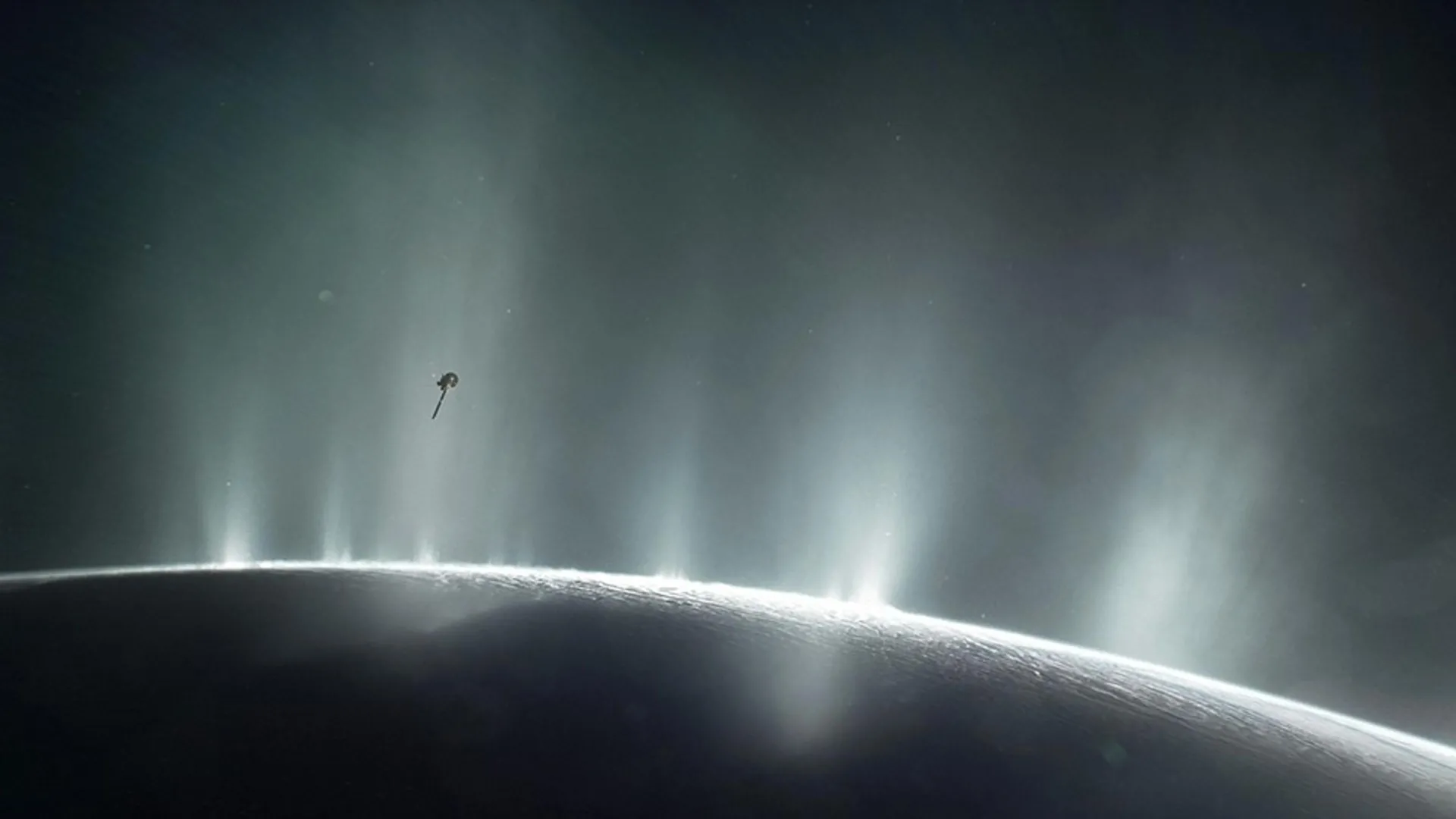
Saturn's moon Enceladus is covered by a thick icy shell, beneath which lies a global ocean. At the southern pole, the surface cracks, forming fissures through which water and steam are ejected into space, creating characteristic geysers.
From 2004 to 2017, the Cassini spacecraft, using the Cosmic Dust Analyzer (CDA), measured the composition of individual icy particles entering Saturn's E-ring. Scientists analyzed 961 mass spectra of so-called type 3 particles, rich in salts, and found significant differences in their chemical composition.
The diversity that raised questions
Some particles turned out to be enriched with sodium chloride, others with carbonates, phosphates, or potassium chloride. It is particularly noteworthy that chloride and carbonate almost never occur in the same sodium-rich particle. If all particles originate from a single ocean, such diversity seems unexpected.
To determine the cause, scientists from the Earth‑Life Science Institute (ELSI) at the Tokyo Institute of Science created laboratory models. They formed droplets ranging from tens to two hundred micrometers in diameter, containing the main salts presumably present in the ocean of Enceladus, and froze them at different cooling rates.
The results showed that during slow freezing (≈10 K/min or slower), salts separate into distinct areas within the crystalline structure. During rapid freezing, the chemical components remain more evenly distributed. Thus, even droplets formed from the same oceanic water can become chemically heterogeneous after freezing.
Researchers suggested that such large droplets form deep within underground vents, where they move slowly, gradually cooling down. As they progress towards the surface, they freeze, allowing the salts to separate. Then, upon encountering narrower channels and an accelerating gas flow, the frozen droplets break into small particles, each carrying a unique set of salts.
This model changes the previous understanding that oceanic spray freezes instantly and immediately shoots into space. It is now believed that the freezing process can take a significant amount of time, and the chemical diversity of ice in the E-ring is a natural consequence of different freezing rates in underground fractures.
Understanding these mechanisms is important not only for interpreting Cassini data but also for assessing the potential habitability of subsurface oceans. Chemical gradients formed during slow crystallization can create microenvironments suitable for microbial life.
Source: ScienceDaily