South Korean scientists created a lead‑free perovskite sensor for ammonia
- The antimony perovskite sensor detects ammonia at 1 ppm
- The current response reaches 235% at 100 ppm of gas
- Lead-free material is safer than traditional perovskites
- The study was published in the journal Small Structures
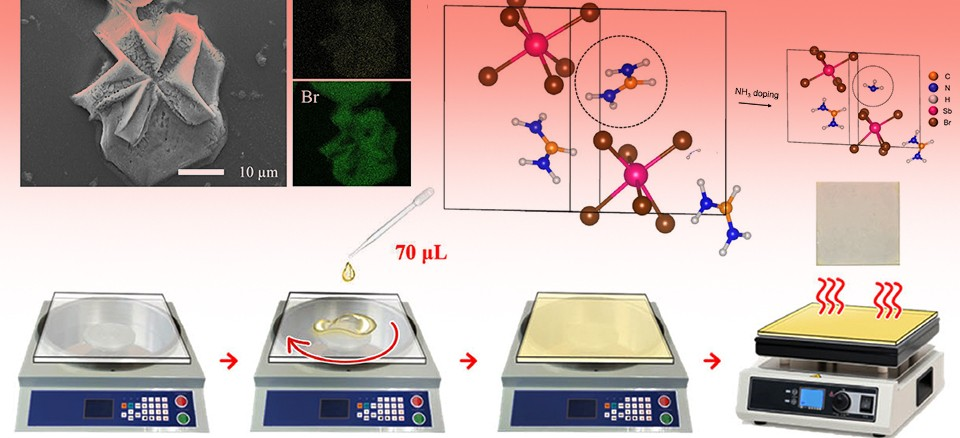
A group of materials scientists from South Korea has introduced a new type of film gas sensor based on lead-free perovskite, in which antimony (Sb) is used instead of lead. The synthesis of the material and its subsequent application to a substrate allowed for the creation of a uniform thin film capable of responding to the presence of ammonia in the air.
The sensor demonstrates outstanding sensitivity: a measurable signal is detected at an ammonia concentration of 1 ppm (parts per million). At a higher pollution level of 100 ppm, the current response increases to 235% of the baseline, indicating high linearity and dynamic range of the sensor.
Advantages of lead-free perovskite
The main advantage of the new development is the absence of lead, which is traditionally used in perovskite sensors but poses serious environmental and health risks. The toxicity of lead limits the scalability of production and requires complex disposal methods. Replacing it with antimony makes the process safer and meets the growing demands for the environmental friendliness of electronics.
In addition, the new sensor may become a competitor to widely used bismuth-based sensors. Bismuth materials, while less toxic, often suffer from limited availability and lower stability during long-term operation. Antimony perovskites show comparable or even better sensitivity performance, paving the way for more reliable solutions.
A study describing the synthesis, structural analysis, and electrical properties of the sensor was published in a peer-reviewed journal Small Structures. The authors detailed the methodology for obtaining perovskite films, their crystalline orientation, and the mechanisms of ammonia interaction with the material's surface.
The development fits into the global trend of transitioning to environmentally friendly materials in sensor technologies. Strict regulations on the use of hazardous substances in electronics stimulate the search for alternatives that can maintain or improve technical characteristics without harming health and the environment.
The prospects for further development include testing the long-term stability of the sensor, integration into portable analytical devices, and expanding the range of detectable gases. If these tasks are successfully addressed, lead-free perovskite sensors could find applications in industrial monitoring, agriculture, and security systems.
Source: N+1