Restoring Ukraine's energy infrastructure: why it matters
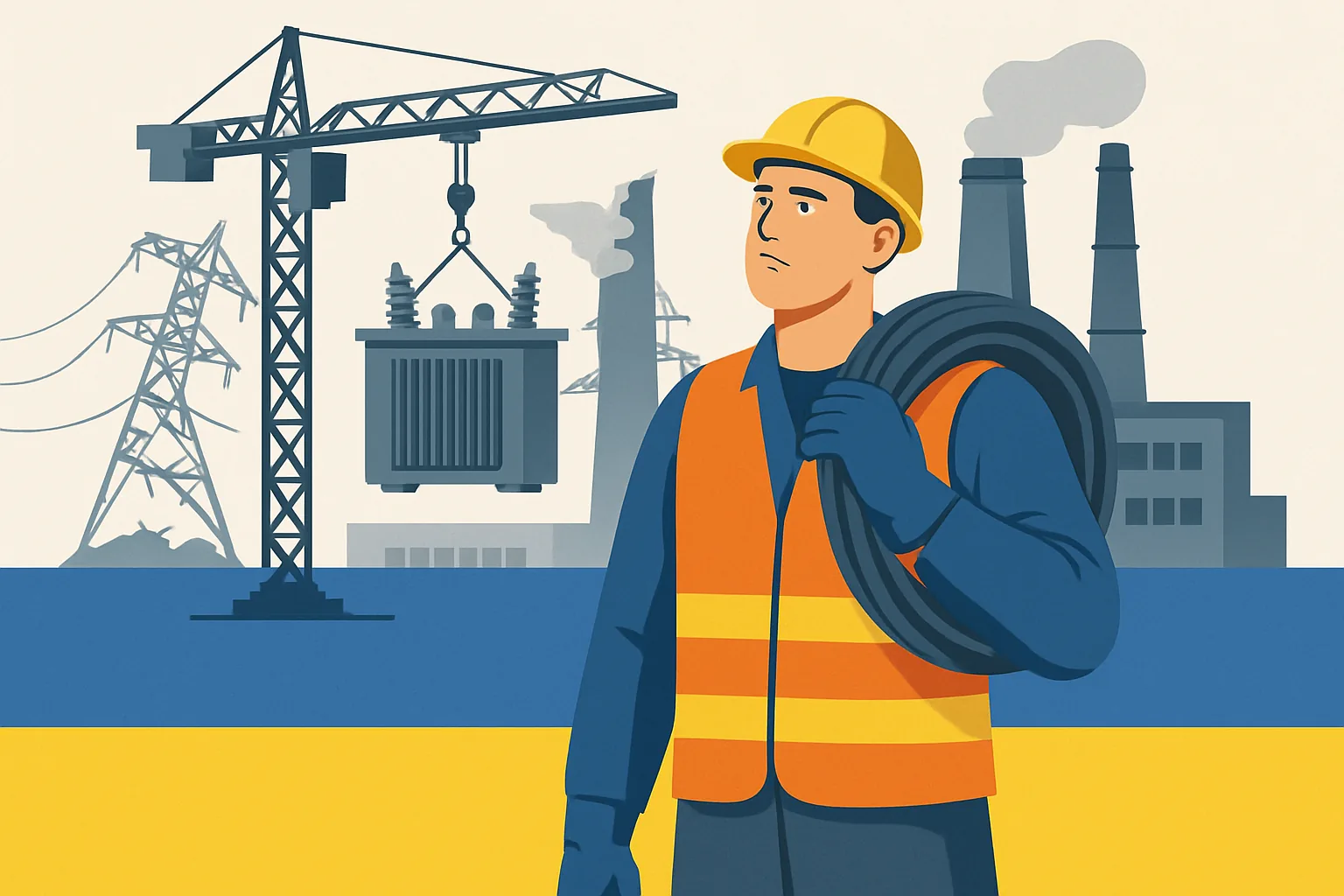
Why the restoration of Ukraine's energy system is important now
The restoration of Ukraine's energy infrastructure is being discussed not only by engineers today. It concerns the operation of hospitals, water utilities, transportation, and communication. If the network fails for a day, millions of people feel it, and businesses lose not only money but also predictability, without which it is impossible to plan shifts, supplies, and payments.
The energy system is not a single object, but a connected chain. When one node fails, a cascade follows: the load is redistributed, emergency risks increase, and the operator has to act around the clock. That is why the restoration of Ukraine's energy infrastructure cannot be reduced to a simple 'fix and turn on'.
There is also a domestic side. In winter, one district without electricity is not an abstraction, but cold apartments, closed schools, and overcrowded heating points. In summer, the same district may be left without pumping stations and normal water supply. Against this backdrop, the resilience of the network becomes a matter of everyday life, not industry statistics.
Sometimes it's useful to look at a problem without dry technical jargon. The energy system does not have the right to a long pause. It must operate.
What objects are included in the energy infrastructure
At the core are several levels. The first is generation: power plants that produce electricity. The second is substations, where voltage is transformed and distributed. The third is power transmission lines, along which energy moves over long distances.
This is supplemented by distribution networks that deliver electricity to urban neighborhoods, villages, and industrial sites. A separate layer is fuel logistics, without which thermal stations and backup capacities do not operate. There is also dispatch management, where decisions about flows, repairs, and switches are made around the clock.
To the reader, this sounds like a set of technical terms, but in practice, each element has its own vulnerability. A substation can withstand one hit and lose a transformer. A line may be intact, but the distribution network may have already sagged after several emergency switches. At this point, it is appropriate to recall that the restoration of Ukraine's energy infrastructure is not following a single scheme, but rather a multitude of parallel ones.
If simple logic is needed, it looks like this: generation produces, the substation transforms, the network delivers, the dispatcher manages. Remove one node — and the chain breaks.
The main causes of damage and vulnerability of the system
The first reason is obvious: combat operations. Substations, lines, and equipment storage facilities are damaged, and often objects that cannot be quickly replaced suffer. The second reason is wear and tear. Some networks were built decades ago, and without regular replacement, they lose their strength.
There are also less noticeable factors. Interruptions in equipment supply slow down repairs because a transformer cannot be 'printed' on-site. Metals, insulation, precise assembly, transportation, and installation are needed. If any stage is missed, recovery slows down.
Another vulnerability is the complexity of the system's synchronous operation. After damage, the load is redistributed, and the network begins to operate at its limits. One unsuccessful overload, and an accident occurs in another area. In this sense, restoring Ukraine's energy infrastructure is like repairing a bridge while traffic is moving: you can't close everything at once, and stopping creates new losses.
No loud formulations are needed for example. One fact is enough: the older the equipment, the higher the risk of a chain accident. This is not theory, but a practical limit.
How recovery proceeds: stages and approaches
The first stage is emergency repairs. Their goal is simple: to restore at least partial power supply and eliminate the most dangerous damages. Often, these are temporary schemes, backup lines, mobile solutions, and load switching to other nodes. They work quickly, but without illusions: temporary does not equal sustainable.
The second stage is temporary stabilization. Here, temporary transformers are installed, cable sections are changed, supports are reinforced, and communication between substations is restored. At this stage, two things are important: speed and accuracy. A mistake during switching can de-energize the area again, and then the entire repair chain rolls back.
The third stage is capital recovery. It is no longer patching, but replacing serious nodes, designing a new power supply scheme, and updating protective automation. Ideally, modernization is immediately included here so that the recovery of Ukraine's energy infrastructure does not repeat old weaknesses.
The fourth stage is increasing resilience. This is not a decoration of the process, but a practical measure: dividing the network into more flexible contours, reserving critical routes, preparing locations for mobile installations. And yes, sometimes the best repair is the one after which the system operates differently than before the damage.
On paper, the stages appear linear. In reality, they often occur simultaneously: emergency repairs in one area, design in another, and cable delivery in a third. It simply cannot be otherwise.
The role of the state, energy companies, and international aid
Here, not only hierarchy is important, but also coordination. Government bodies set the rules, priorities, and protection regimes for facilities. Network operators are responsible for technical solutions and operational switches. Contractors handle installation, logistics, and specialized work. Without this connection, repairs turn into a series of disjointed trips.
International aid covers part of the deficit: equipment, financing, expert support, and sometimes emergency kits. In such programs, the speed of approval and clear procedures are especially valued. If paperwork takes longer than the cargo, recovery is delayed even before work begins.
It is useful to look at the distribution of responsibility. The state does not repair every support, and the energy company does not conduct diplomatic negotiations for assistance. Each side has its own area. When this area is clear, the restoration of Ukraine's energy infrastructure proceeds more smoothly and without unnecessary time losses.
A small detail, but it explains a lot: repairing a substation without protecting the surrounding area almost always leads to repeated risks. This means that work should be done not only on the facility but also around it.
If you want to take a break from a heavy topic for 5 minutes, you can watch jokes about students. Jokes for free. Short. The pause is short, and then back to business.
Technologies used in modernization
Digital monitoring helps to detect a failure before it escalates. Sensors at substations and lines transmit parameters to the dispatch center, where overheating, voltage drops, or abnormal modes can be quickly noticed. This is not magic, but ordinary data discipline.
Distributed generation reduces dependence on a single large source. When there are local installations in the system, a neighborhood or enterprise remains more resilient during a failure on the main line. This is especially valuable for Ukraine in areas where restoring the energy infrastructure requires not only repairs but also a new power architecture.
Energy storage systems are also part of the practical toolkit. They smooth out peaks, support critical loads, and provide a few extra minutes or hours that can sometimes determine the outcome of an emergency. During this time, the dispatcher can switch the network to backup mode.
Separately, there are protective measures for critical nodes: reinforced enclosures, screens, thoughtful redundancy, and equipment separation. When a node is designed with 2 levels of protection, the consequences of an attack or failure are not as severe. And this is not an abstract engineering dream, but a concrete way to reduce downtime.
There is also a digital aspect to security. The more accurate the network map, the faster the engineer can see where the break is, where the overload is, and where the false signal is. On old schematics, this takes more time.
Main risks and limitations of recovery
The first risk is equipment shortage. Transformers, switches, relay automation, and cable products are not always available on-site, and their delivery depends on routes, customs, and manufacturers' schedules. One component can delay the entire node.
The second risk is work safety. The crew cannot stay on-site for long if the area is at risk of a repeat strike or if there are still uncleared areas nearby. Here, the pace of repairs is inevitably limited. You cannot put people at risk for the sake of a nice report.
The third risk is finances. The recovery of expensive nodes goes hand in hand with everyday operational expenses. There is always less money than desires. This is hard math.
The fourth risk is the simultaneous need to repair and protect. If an object is restored but not reinforced, a new accident can repeat the old scenario. Therefore, the restoration of Ukraine's energy infrastructure often follows the scheme of 'repair plus protection' rather than 'repair then separately protect.'
There are also organizational limitations. Coordination between regions, contractors, and the central level sometimes takes more time than the installation itself. This pause is also costly.
If you need an example of how people simplify complex things, look at how to check a website for fraud. In energy, the logic is similar: first check, then act.
What can accelerate long-term recovery
First — normal planning. Not a set of urgent solutions, but a priority map for 6, 12, and 24 months. When it is known which nodes are critical, resources are used more wisely, rather than on the principle of 'where the accident is loudest.'
Second — transparent coordination. If the government agency, operator, and contractor have one working scheme for information exchange, the time between damage and response is reduced. Sometimes, it’s not hours that are saved, but whole days. For the energy system, this makes a huge difference.
Third — modernization based on the principle of build back better. The restoration of Ukraine's energy infrastructure should not return the country to its previous fragile state. After repairs, the network should be rebuilt in such a way that it has more reserves, greater local flexibility, and fewer single points of failure.
The fourth is strengthening local resilience. The more prepared teams, spare materials, and standard solutions there are on the ground, the less dependence there is on the center. This is especially noticeable in remote areas, where the road to the site can itself become a problem.
The fifth is working with the habit of long repair cycles. The energy system is not repaired in one season. And it shouldn't be. When goals are outlined in several stages, it is easier to maintain the pace and not fall into chaos.
If you need an outside perspective and a little breather, you can open secrets of the ocean. And then it's back to the networks, substations, and the solutions that determine the light in homes and the functioning of entire cities.